Clogged Drain Repair in Denver, CO
One fixture holding water, or the whole floor of the house slowing down? We answer 24/7 across Denver, work out whether the blockage is local or in the main, and cut it to full pipe diameter so it does not close again next week.
Quick answer
Why does the same drain keep clogging in my Denver house?
A Denver drain that clogs repeatedly usually has a structural cause rather than a habit problem: root intrusion at a clay joint, a sag holding standing water, or grease hardened onto the pipe wall in an unheated crawl space. Clearing without a camera treats the symptom and leaves the cause in place.
Updated August 2026 by Colton Brackett, Lead Plumber
What this work actually covers
The first useful question on any clogged drain is how many fixtures are affected. A single slow bathroom sink is almost always a local problem in the trap or the branch line within a few feet. Everything on one floor slowing together points further downstream, usually at the stack or the main lateral.
The second question is what changed. A drain that has slowed gradually over months is accumulating something: grease in a kitchen line, hair and soap in a bathroom, or scale on old galvanized. A drain that stopped suddenly with no warning is usually obstructed by an object or by a root mass that finally closed the last available gap.
Those two answers decide the tool, the access point, and whether a camera belongs on the visit.
Warning signs
Signs the problem is already under way
Water standing after the tap closes
A partial obstruction still passes water, just far slower than the fixture was designed to drain.
Bubbling in a nearby fixture
Air displaced through a shared line indicates the restriction sits past both fixtures.
The toilet drops slowly then recovers
Classic partial main line restriction rather than a blocked toilet trap.
Odor rising from the drain
Waste sitting in a line instead of moving through it produces smell before it produces backup.
The same fixture blocking every few weeks
Recurrence at a short interval indicates a structural cause worth putting a camera on.
Water appearing at the lowest drain
When the main is involved, the basement floor drain is where it surfaces first.
What happens after you call
You tell us what is affected
One fixture or several, sudden or gradual, and whether anything surfaced at a floor drain.
The right access is opened
Correct cleanout selection protects your finishes and reaches the blockage directly.
The blockage is cut, not punctured
Cutter head sized to the pipe so the full diameter is restored.
The line is tested under load
Running volume through the line proves it clears rather than assuming it does.
You hear whether it returns
Where a structural cause exists, you get the honest interval and the repair options.
How long the work takes
Most branch line clogs are cleared inside an hour. Main lateral work generally runs one to three hours depending on the distance from the cleanout and how dense the obstruction turns out to be.
Camera inspection adds roughly twenty to forty minutes. On any main line involvement that time pays for itself, because it decides whether you are budgeting for maintenance or for a repair.
The detail that matters
What actually goes wrong, and why here
Kitchen lines and bathroom lines fail for different reasons, and treating them the same is why repeat visits happen. A kitchen branch accumulates grease that cools and hardens against pipe running through an unheated Denver crawl space. The deposit narrows the bore over months until a single heavy wash finishes the job.
Bathroom branches accumulate hair bound together with soap scum, which forms a fibrous plug that grabs anything passing. Both respond to cabling, but the cutter head that clears grease efficiently is not the one that pulls a hair mass out intact.
Main line blockages are a separate category entirely. Once several fixtures are involved the obstruction sits in shared pipe, often the lateral running under the yard, and the likely cause in older Denver neighborhoods is root intrusion at a mortared clay joint. That is where a camera run stops being optional, because it separates a maintenance interval from a repair you should be planning.
Whole floor of the house draining slowly?
When several fixtures slow together the restriction has reached shared pipe, and continued use pushes more of it back toward you.
Call (720) 698-9746Brands We Service
- Rheem
- A.O. Smith
- Bradford White
- Navien
- Rinnai
- Weil-McLain
- Burnham
- Moen
- Kohler
- Zoeller
What a clogged drain visit covers
- Working out whether the blockage is local or in the main
- Locating and opening the correct cleanout access
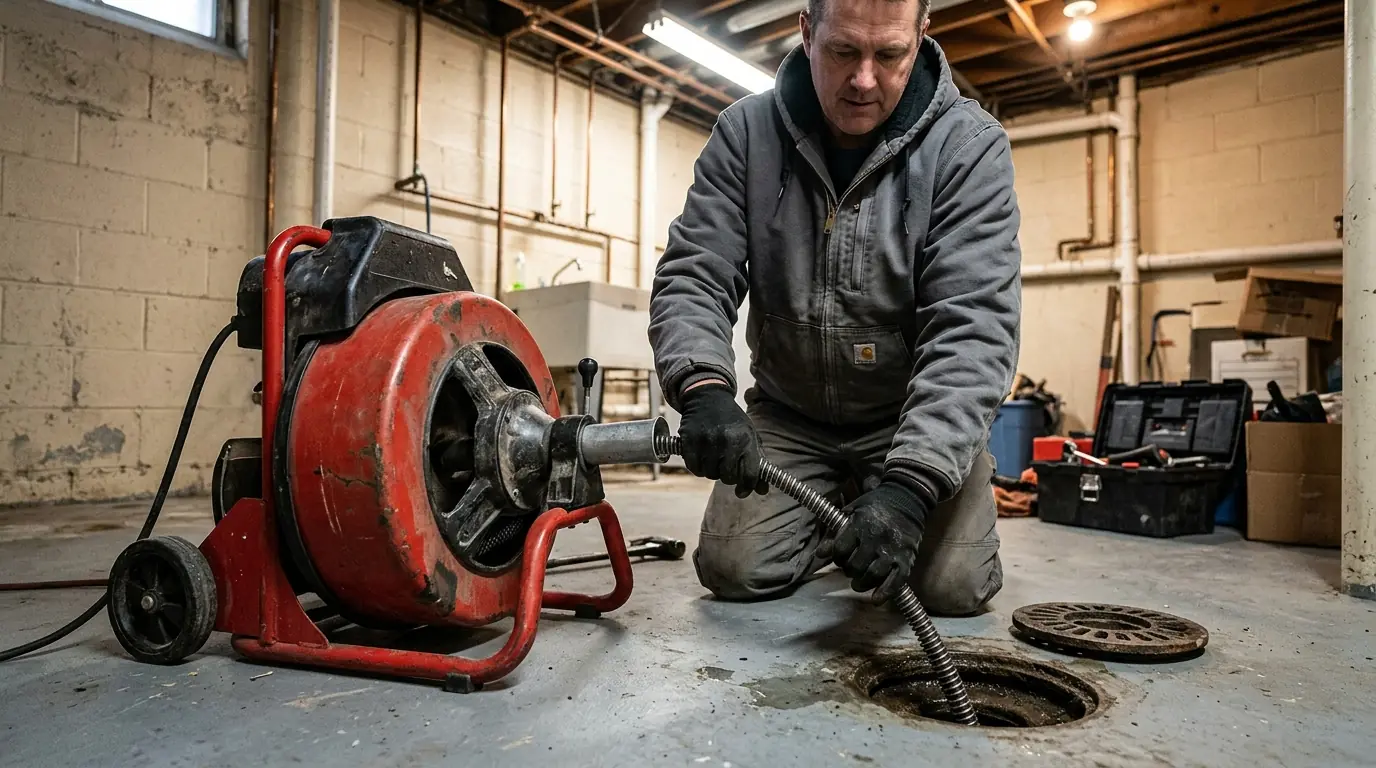
- Cable and cutter head matched to the pipe and the blockage type
- Cutting the obstruction to full pipe diameter
- Running water under load to confirm the line actually clears
- Camera inspection where the main line is involved
- Photographs of the cause where one is visible
- A written verdict on whether recurrence should be expected
What you get
What changes after the visit
Local and main blockages get told apart
The diagnosis decides the tool, and the wrong tool wastes your money.
The line is cut to full diameter
Boring a channel through a blockage produces a fast result and a fast repeat.
Cause identified on main line work
A camera turns guesswork into a decision you can actually budget for.
Fixtures and finishes protected
Correct cleanout access avoids pulling toilets and cutting into finished ceilings.
No chemical damage to old pipe
Drain acids attack cast iron and clay, and Denver has plenty of both.
Handling it yourself against calling us
| Factor | Doing it yourself | Calling us |
|---|---|---|
| Single slow sink | A plunger and a chemical that may damage old pipe | Trap and branch cleared with the right cable |
| Toilet that will not clear | Repeated plunging that pushes the object further | Auger or removal, depending on what the camera shows |
| Whole floor backing up | A rented machine with no diagnosis | Main lateral cleared, then camera verified |
| Recurring blockage | Clearing again every few weeks | Structural cause identified so the cycle can end |
| Old cast iron | Acid that eats the remaining pipe wall | Mechanical clearing that leaves the pipe intact |
Denver rules and local conditions that apply
In Denver the property owner is responsible for the sewer lateral all the way to the city main, including the section beneath the street. That is why a root problem in the parkway is a homeowner expense rather than a utility one.
Housing platted before the 1970s across Park Hill, Berkeley, Capitol Hill, and Washington Park commonly carries clay lateral pipe, and the mature street trees above those runs are the usual source of intrusion.
Budgeting
What moves the price up or down
Local branch against main line
Branch work sits well below main lateral clearing on both time and equipment.
Cleanout availability
No accessible cleanout means pulling a fixture or working from the roof, which adds labor.
What is blocking the line
Soft grease clears quickly; a dense root mass in clay takes considerably longer.
Camera inspection
Included on main line visits, priced separately when requested on a branch.
Scheduling
After hours and weekend dispatch carry a higher rate than a booked weekday slot.
Why this crew
Why homeowners call us back
One point of accountability
The technician who diagnoses the problem stands behind the repair.
Built for Front Range conditions
Hard water, expansive clay, and a deep frost line shape every recommendation.
Priced before work starts
Written figures, no hourly surprises, and a straight answer on the cheaper path.
Old systems taken seriously
Prewar boilers, cast iron stacks, and clay laterals get repaired where repair is honest.
Common questions
Questions we field on this work
No. Those products rarely reach a real blockage, damage cast iron and clay, and create a burn hazard for whoever opens the line afterward.
Because the first clearing punched a channel through the blockage rather than cutting to full diameter, or because roots or a sag remain in the line.
Usually not. A single affected fixture points at a local branch problem, which is the least expensive category of drain work.
The main lateral is restricted. Stop using water upstairs and treat it as urgent, because every fixture used adds to what surfaces.
Often, with a closet auger. When an object is lodged in the trap, pulling the fixture is faster and safer than forcing it through.
On main line work, yes. On a single slow sink it is available but rarely worth the cost.
Then you get repair options priced honestly, from a spot repair to trenchless lining, with the tradeoffs explained.
For heavy grease and scale, yes, because it scours the wall. For a root mass, cutting comes first. Jetting is covered separately.
Yes. Commercial kitchens in particular benefit from a scheduled interval rather than reactive calls.
Get the blockage cut properly the first time
Full diameter clearing and an honest answer about whether it returns.