Hydro Jetting in Denver, CO
Line clearing every few months instead of every few years? Hydro jetting scours the pipe wall back to full bore rather than cutting a channel through the buildup, which is what changes the interval on grease and scale.
Quick answer
What does hydro jetting do that cabling does not?
Hydro jetting uses water at high pressure through a directional nozzle to strip grease, scale, and root hair off the full interior wall of a pipe, restoring the original bore. A cable cuts a channel through an obstruction and leaves the surrounding buildup in place, which is why cabled lines on heavy grease often reblock within months.
Updated August 2026 by Colton Brackett, Lead Plumber
What this work actually covers
Cabling and jetting solve different halves of the same problem. A cable is a mechanical cutter that removes what is directly in its path, which makes it excellent at punching through a dense root mass or retrieving an object. What it does not do is clean the pipe wall behind it.
Jetting works the opposite way. Water leaving a nozzle at high pressure, directed backward against the pipe wall, lifts deposits off the surface and flushes them downstream. On a kitchen line carrying twenty years of hardened grease the difference is dramatic: the bore returns to something close to its original diameter rather than to whatever the cutter head cleared.
The tradeoff is that jetting asks more of the pipe. Fragile clay, badly corroded cast iron, or a line with an existing crack can be damaged by pressure that a sound pipe shrugs off, which is why a camera inspection belongs before the jetter rather than after.
The detail that matters
What actually goes wrong, and why here
Nozzle selection carries most of the outcome. A penetrating nozzle with a forward jet opens a path through a solid obstruction, while a flushing nozzle with rear facing jets pulls the hose along and strips the wall as it travels. Root cutting requires a rotating head that trims growth from the joint face without loading the pipe.
Pressure and volume matter differently than most people assume. Very high pressure at low flow cuts well but flushes poorly, so debris settles again downstream. Adequate flow is what actually carries the material out to the main, which is why a jetter is rated on both numbers rather than on pressure alone.
The decision about whether to jet at all comes from the camera. Sound cast iron and modern PVC take jetting comfortably. Deteriorated clay with open joints, or cast iron that has lost significant wall thickness, may need lining instead, and jetting a pipe in that condition can convert a manageable problem into an excavation.
What you get
What changes after the visit
The pipe returns to full bore
Removing wall deposits restores capacity a cable cannot recover.
Intervals stretch out
Properly jetted lines commonly go years rather than months between service.
Root hair is stripped, not just cut
Fine regrowth is removed from the joint surface along with the mass.
Pipe condition is verified first
Camera inspection before jetting prevents damaging a line that cannot take pressure.
The result is visible on camera
You see the before and after rather than taking a description on trust.
What a jetting visit includes
- Camera inspection to confirm the pipe can take pressure safely
- Locating the correct access point for the run
- Nozzle selected for grease, scale, or root conditions
- Pressure and flow set to the pipe material and diameter
- The full run jetted rather than only the blocked section
- Debris flushed through to the main rather than left downstream
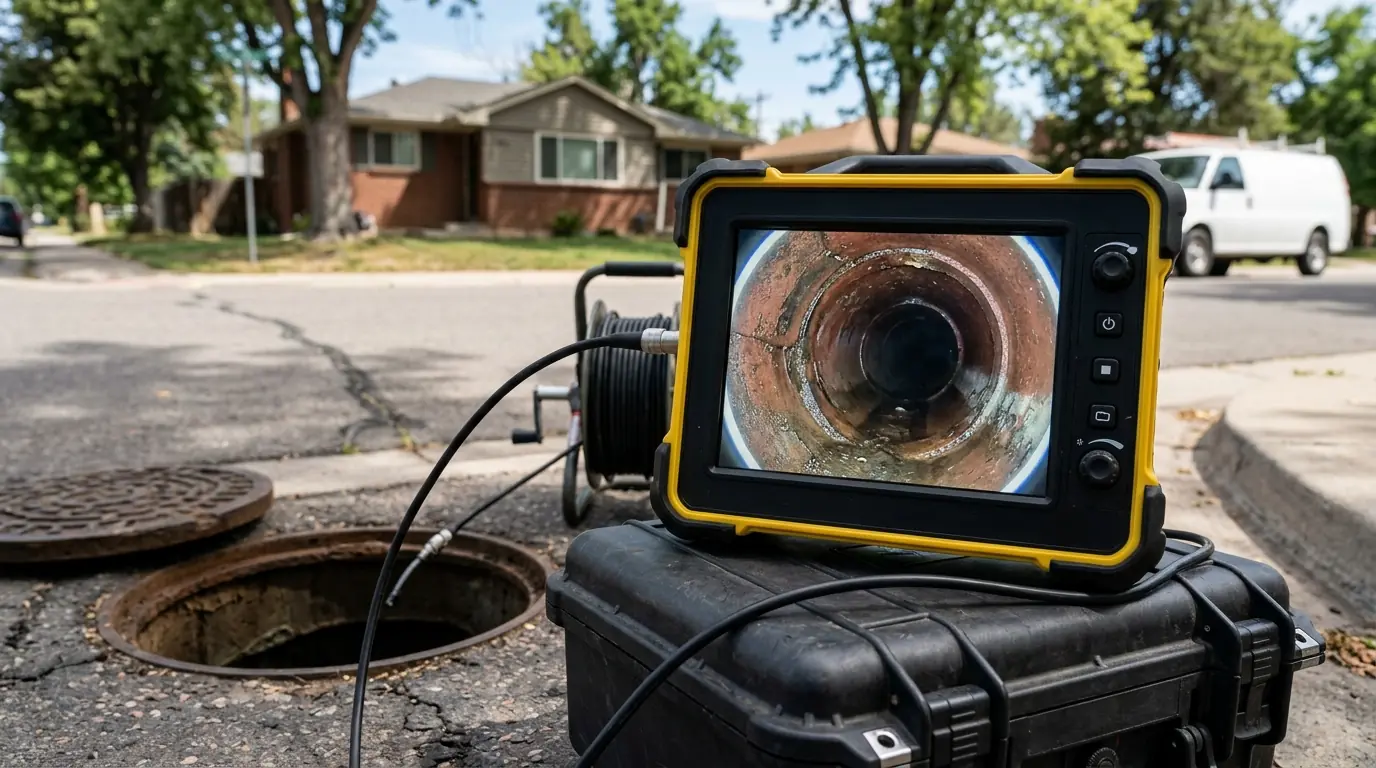
- Second camera pass showing the cleaned wall
- A written service interval recommendation for the line
Warning signs
Signs the problem is already under way
Clearing needed more than once a year
Short intervals signal wall buildup that cabling is not removing.
Kitchen line slowing again within months
Grease reforms fast on a wall that was never actually cleaned.
Scale visible on camera footage
Mineral crust on the pipe wall narrows the bore permanently until it is stripped.
Recurring root hair after cutting
Fine root regrowth returns quickly when the entry point remains open.
Slow drainage across several fixtures
Shared line restriction from wall buildup rather than a single blockage.
A commercial kitchen on reactive service
Restaurant lines almost always need scheduled jetting rather than emergency calls.
Clearing the same line twice a year?
That interval is telling you the wall was never cleaned, only channelled through. Jetting changes the interval rather than the symptom.
Call (720) 698-9746Brands We Service
- Rheem
- A.O. Smith
- Bradford White
- Navien
- Rinnai
- Weil-McLain
- Burnham
- Moen
- Kohler
- Zoeller
How long the work takes
A residential kitchen or lateral jetting visit generally runs two to three hours including both camera passes. Long commercial runs and heavily scaled lines extend beyond that and occasionally need a second session.
The interval afterward depends on what the camera showed. A sound line carrying normal household waste commonly goes several years, while a restaurant grease line may need scheduled service two or three times a year.
What happens after you call
The line is inspected on camera first
Pipe material and condition decide whether jetting is safe and what pressure suits it.
Access and nozzle are selected
Cleanout choice and head type are matched to the run and the deposit.
Pressure and flow are set to the pipe
Enough to strip the wall, never enough to load a compromised line.
The full run is jetted
Working the whole length prevents debris resettling just past the cleared section.
A second camera pass confirms the result
You see the cleaned wall and get an interval recommendation in writing.
Denver rules and local conditions that apply
Denver homeowners own the lateral to the city main, so both the buildup and the pipe condition inside it are the property owner's responsibility rather than the utility's.
Clay laterals under mature tree cover in Park Hill, Berkeley, and Washington Park are the lines where the camera first rule matters most, because open joints and pressure interact badly.
Handling it yourself against calling us
| Factor | Doing it yourself | Calling us |
|---|---|---|
| Grease buildup | Boiling water that moves the deposit further along | Wall scoured back to original bore |
| Root hair | Cutting the mass and leaving fine regrowth | Rotating head strips growth from the joint face |
| Fragile clay pipe | Pressure applied without knowing pipe condition | Camera first, and lining recommended where jetting is unsafe |
| Commercial kitchens | Emergency calls when the line finally stops | Scheduled interval based on measured buildup rate |
| Verification | Assuming it worked because water drains | Second camera pass showing the actual wall |
Budgeting
What moves the price up or down
Line length and diameter
Longer runs and larger mains take more time and more water volume.
Camera inspection
Required before jetting, and included as part of the visit.
What is being removed
Soft grease strips quickly; hardened scale and heavy root growth take multiple passes.
Access
A missing or buried cleanout adds excavation or fixture removal before jetting begins.
Commercial against residential
Restaurant grease lines run longer and need heavier equipment than a house lateral.
Why this crew
Why homeowners call us back
One point of accountability
The technician who diagnoses the problem stands behind the repair.
Built for Front Range conditions
Hard water, expansive clay, and a deep frost line shape every recommendation.
Priced before work starts
Written figures, no hourly surprises, and a straight answer on the cheaper path.
Old systems taken seriously
Prewar boilers, cast iron stacks, and clay laterals get repaired where repair is honest.
Common questions
Questions we field on this work
Not a sound pipe. On deteriorated clay or thin cast iron it can, which is exactly why the camera inspection comes first rather than afterward.
A cable cuts a path through a blockage. Jetting strips deposits off the entire pipe wall and restores the original diameter.
It depends on what the camera shows. Household laterals commonly go years; commercial kitchen lines often need service two or three times a year.
It removes the growth thoroughly, but the entry point remains. Permanent solutions are lining or replacing the affected section.
On commercial kitchens and on residential lines with a known buildup history, yes. On a line with no history it is usually unnecessary.
A working session uses a meaningful volume, though far less than the repeated service visits it replaces.
No. Jetting works through existing cleanout access, which is one of its main advantages.
Jetting stops and you get repair options instead, priced honestly rather than jetting a line that needs replacing.
Yes, though a sag will keep collecting debris regardless. The camera tells you whether the sag is the real problem.
Get the pipe wall actually cleaned
Camera first, jetting matched to the pipe, and footage of the result.