Trenchless Sewer Repair in Denver, CO
Facing a lateral repair under a driveway, a patio, or a fifty year old tree? Trenchless lining rebuilds the pipe from the inside through existing access points, which is why it often costs less overall despite higher equipment cost.
Quick answer
Can any Denver sewer line be repaired trenchless?
Trenchless lining works in Denver when enough of the host pipe remains intact to support the liner, generally meaning sound clay or cast iron with joint separation and root intrusion rather than collapse. Deformed Orangeburg, fully collapsed sections, and severe sags are not candidates, and a camera survey establishes which category a line falls into.
Updated August 2026 by Colton Brackett, Lead Plumber
What this work actually covers
Trenchless repair covers two distinct methods, and they suit different failures. Cured in place lining pulls a resin saturated tube through the existing pipe and cures it into a new jointless pipe within the old one. Pipe bursting fractures the old pipe outward while pulling a new one into the space it occupied.
Lining suits pipes that are structurally present but leaking: separated joints, root intrusion, hairline cracks, and corrosion. The host pipe becomes the mould, and the finished liner seals every joint along its length, which removes root entry points permanently.
Bursting suits pipes that are too far gone to host a liner but sit in ground that allows displacement. It is also the method when a larger diameter is wanted, since the new pipe is not constrained by the old bore.
Budgeting
What moves the price up or down
Length of the lined section
Liner material and curing time both scale with the run.
Host pipe preparation
Heavy root growth or scale needs cleaning and jetting before lining can proceed.
Access availability
An existing usable cleanout avoids pit excavation and reduces cost meaningfully.
Branch reinstatement
Each connection along the lined section has to be reopened after curing.
Surface above the run
The savings are largest where hardscape or mature planting would otherwise be destroyed.
Handling it yourself against calling us
| Factor | Doing it yourself | Calling us |
|---|---|---|
| Under a driveway | Cutting and replacing concrete after trenching | Lining through existing access, hardscape untouched |
| Mature trees | Excavation through the root plate | Root entry sealed without disturbing the tree |
| Multiple failed joints | Individual repairs at each defect | One liner sealing the full run at once |
| Sags in the line | Assuming lining fixes grade | Grade problems identified and priced separately |
| Timeline | Several days of open excavation | Most residential runs completed in a day |
What a trenchless repair covers
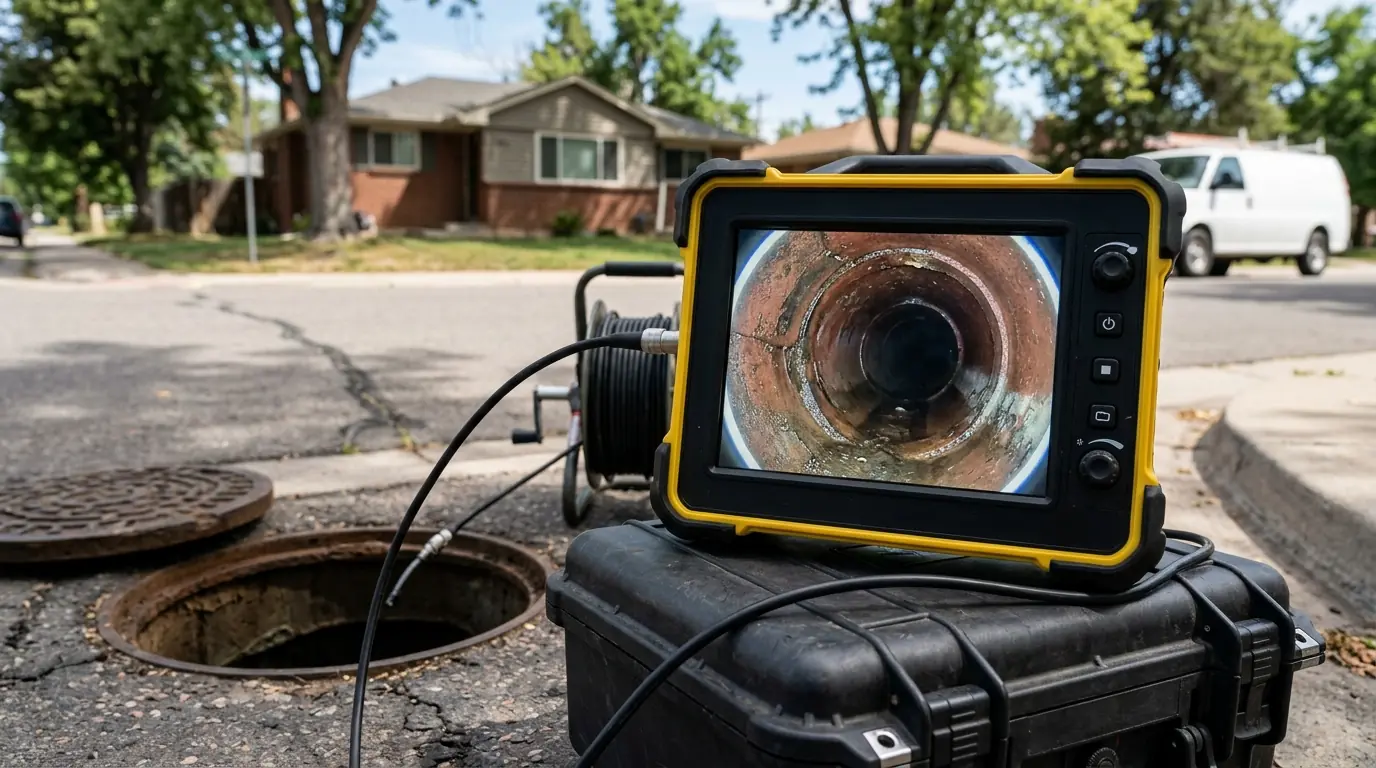
- Full camera survey establishing host pipe suitability
- Cleaning and root cutting to prepare the bore for lining
- Measurement and liner sizing to the run length and diameter
- Access pit excavation only where existing cleanouts cannot serve
- Liner installation and controlled curing
- Reinstatement of any branch connections along the lined section
- Denver permit pulled and inspection coordinated
- Final camera pass confirming the finished liner
The detail that matters
What actually goes wrong, and why here
The honest limitation of lining is that it needs a host. The liner takes the shape of the pipe it cures inside, so a sag stays a sag and an offset joint stays offset. Where the camera shows standing water in a belly, lining seals the leaks but does not correct the grade, and that distinction has to be explained before the work rather than after.
Access is the other consideration. Lining runs from a cleanout or from a small access pit, and the liner has to negotiate the bends between there and the defect. Multiple sharp turns, particularly on older Denver plumbing where the lateral changes direction under the foundation, can put a run outside what lining will manage.
Where lining does fit, the economics usually favour it clearly on properties with hardscape or mature trees above the run. The equipment cost is higher than trenching, but the restoration cost is close to nothing, and on a driveway crossing that difference is decisive. On an open lawn with a shallow line, conventional replacement is often the better value, and we say so.
Repair needed under a driveway or a mature tree?
Excavation there costs far more than the pipe work. Lining is worth pricing before anyone breaks concrete.
Call (720) 698-9746Brands We Service
- Rheem
- A.O. Smith
- Bradford White
- Navien
- Rinnai
- Weil-McLain
- Burnham
- Moen
- Kohler
- Zoeller
What you get
What changes after the visit
Surfaces above the line survive
Driveways, patios, and mature planting stay where they are.
Every joint seals at once
Root entry points along the full lined length are eliminated together.
Flow capacity often improves
A smooth liner interior can carry better than corroded original pipe despite slightly smaller bore.
Work finishes faster
Most residential lining is completed in a day rather than several.
Suitability is verified, not assumed
The camera survey confirms the host pipe can support a liner before anything is quoted.
Denver rules and local conditions that apply
Denver permits and inspects trenchless lateral rehabilitation as it does conventional replacement, and work extending into the public right of way carries additional approval.
Lining is particularly relevant across older Denver neighborhoods where mature elm and cottonwood stand directly over clay laterals, because the excavation alternative frequently destroys the tree.
What happens after you call
The host pipe is surveyed on camera
Suitability for lining is established before any quote is issued.
The bore is cleaned and prepared
Roots and scale are removed so the liner cures against a clean surface.
Liner is sized and access confirmed
Length, diameter, and bend geometry determine what the run will accept.
Installation and curing
The liner is positioned and cured in place, forming a continuous pipe within the old one.
Branches reinstated and result verified
Connections are reopened and a final camera pass confirms the finished bore.
How long the work takes
Most residential lining projects complete in a single day, including preparation, installation, curing, and the final camera pass. Long runs and heavy root preparation extend into a second day.
Where an access pit is required the excavation adds several hours, though it remains far smaller than the trench a conventional replacement would need.
Warning signs
Signs the problem is already under way
Repair needed under a driveway or patio
Restoration of hardscape frequently costs more than the pipe work itself.
A mature tree standing over the run
Excavation through a root plate often kills a tree that took decades to grow.
Root intrusion at several joints
Lining seals every joint at once rather than repairing them individually.
A line running beneath the street
Right of way excavation carries additional permitting and restoration cost.
Recurring backups on sound clay pipe
Intact pipe with failing joints is the ideal lining candidate.
Landscaping you do not want to lose
Established planting is rarely recoverable after full trench excavation.
Why this crew
Why homeowners call us back
One point of accountability
The technician who diagnoses the problem stands behind the repair.
Built for Front Range conditions
Hard water, expansive clay, and a deep frost line shape every recommendation.
Priced before work starts
Written figures, no hourly surprises, and a straight answer on the cheaper path.
Old systems taken seriously
Prewar boilers, cast iron stacks, and clay laterals get repaired where repair is honest.
Common questions
Questions we field on this work
No. The host pipe must be structurally present. Deformed Orangeburg, collapsed sections, and severe sags rule it out, and the camera establishes that first.
Cured in place liners are generally rated for fifty years or more, comparable to new pipe on proper bedding.
Slightly in diameter, though the smooth interior often carries better than the corroded original surface it replaced.
Not for the lined section. An access pit may be needed at one end, positioned away from hardscape wherever possible.
No. Lining seals leaks but follows existing grade. Correcting a sag requires excavation, and we identify that before quoting.
The equipment cost is higher, but total project cost is frequently lower once restoration is included, particularly under hardscape.
They are reopened after the liner cures, which is part of the scope rather than an extra.
Yes, Denver permits and inspects this work. We pull it and coordinate the inspection.
A camera survey answers it in one visit, and that survey is worth doing before accepting any excavation quote.
Find out whether your line can be lined
One camera survey answers it, and it is worth doing before accepting a trenching quote.