Water Heater Repair in Denver, CO
No hot water this morning, or a puddle spreading under the tank? We answer 24/7 across Denver, test the burner, thermostat, and anode before recommending anything, and tell you plainly when repair beats replacement.
Quick answer
Why did my Denver water heater stop making hot water?
A Denver water heater that stops producing hot water has usually failed at one of four points: the thermocouple or igniter, the gas control valve, the upper thermostat on electric units, or the dip tube. Sediment from hard Front Range water accelerates all four, and most are repairable cheaply.
Updated August 2026 by Colton Brackett, Lead Plumber
What this work actually covers
A water heater rarely dies without warning. It degrades, and the warning signs run in a predictable order on Front Range water. First the recovery time stretches, so the second shower runs cool. Then the burner starts short cycling because a sediment layer insulates it from the water above. Finally the tank seam gives out, and by that point repair is no longer on the table.
The reason is mineral content. Water reaching Denver taps carries dissolved calcium and magnesium picked up off mountain rock, and every heating cycle drops some of it to the bottom of the tank. That layer hardens into scale, forces longer burns for the same output, and cooks the steel from the inside.
The practical consequence is that a tank rated for twelve years frequently gives out around year eight in this city when nobody has flushed it.
Warning signs
Signs the problem is already under way
Hot water runs out faster than it used to
Sediment occupies volume that used to hold water, so the usable capacity shrinks.
Rumbling or popping during heating
That sound is water flashing to steam underneath a scale layer at the tank floor.
Rusty or metallic tasting hot water
A spent anode rod leaves the steel tank exposed, and the discoloration follows.
The pilot will not stay lit
Usually a failing thermocouple, which is one of the cheapest repairs on the unit.
Moisture around the tank base
Condensation is normal on a cold morning; a persistent puddle is not.
The relief valve discharges
A T and P valve venting repeatedly signals excess pressure or temperature that needs diagnosis, not a plug.
What happens after you call
You describe the symptom
Cold water, lukewarm water, noise, or a leak each point at a different failure, which shapes what gets carried in.
The unit is tested rather than assumed
Thermostat, thermocouple, element, and valve get checked against readings, not guesses.
Tank condition is assessed
Age, anode state, and sediment level determine whether repair is a sound investment.
You get both numbers
Repair cost and replacement cost, side by side, with an honest recommendation between them.
The work is completed and verified
Recovery is measured after the repair so you leave with a heater that performs to its rating.
How long the work takes
Most component repairs, thermocouples, igniters, elements, and thermostats, are finished within one visit of roughly one to two hours. A full flush adds time depending on how much sediment the tank has accumulated.
Gas control valve replacement runs longer and depends on part availability. When the diagnosis points toward replacement instead, that becomes a separate scheduled visit under water heater installation.
The detail that matters
What actually goes wrong, and why here
The single most useful maintenance item on a Denver water heater is the anode rod, and almost nobody knows it exists. It is a sacrificial magnesium or aluminum rod suspended in the tank that corrodes so the steel does not. On this water it can be consumed in three or four years, and once it is gone the tank itself starts giving up material.
Replacing an anode is inexpensive compared to replacing a heater, but access matters. In tight Denver utility closets there is often not enough headroom to withdraw a full length rod, which is where a segmented rod earns its cost. That is the kind of detail that decides whether a tank reaches year fifteen or year eight.
Sediment is the other half. An annual flush through the drain valve pulls loose material out before it hardens. On a tank never flushed the layer may already be cemented, and aggressive flushing can jam the drain valve open.
Cold showers three mornings running?
Most no hot water calls trace to a component that costs far less than a new tank. Find out which one before replacing anything.
Call (720) 698-9746Brands We Service
- Rheem
- A.O. Smith
- Bradford White
- Navien
- Rinnai
- Weil-McLain
- Burnham
- Moen
- Kohler
- Zoeller
What a repair visit covers
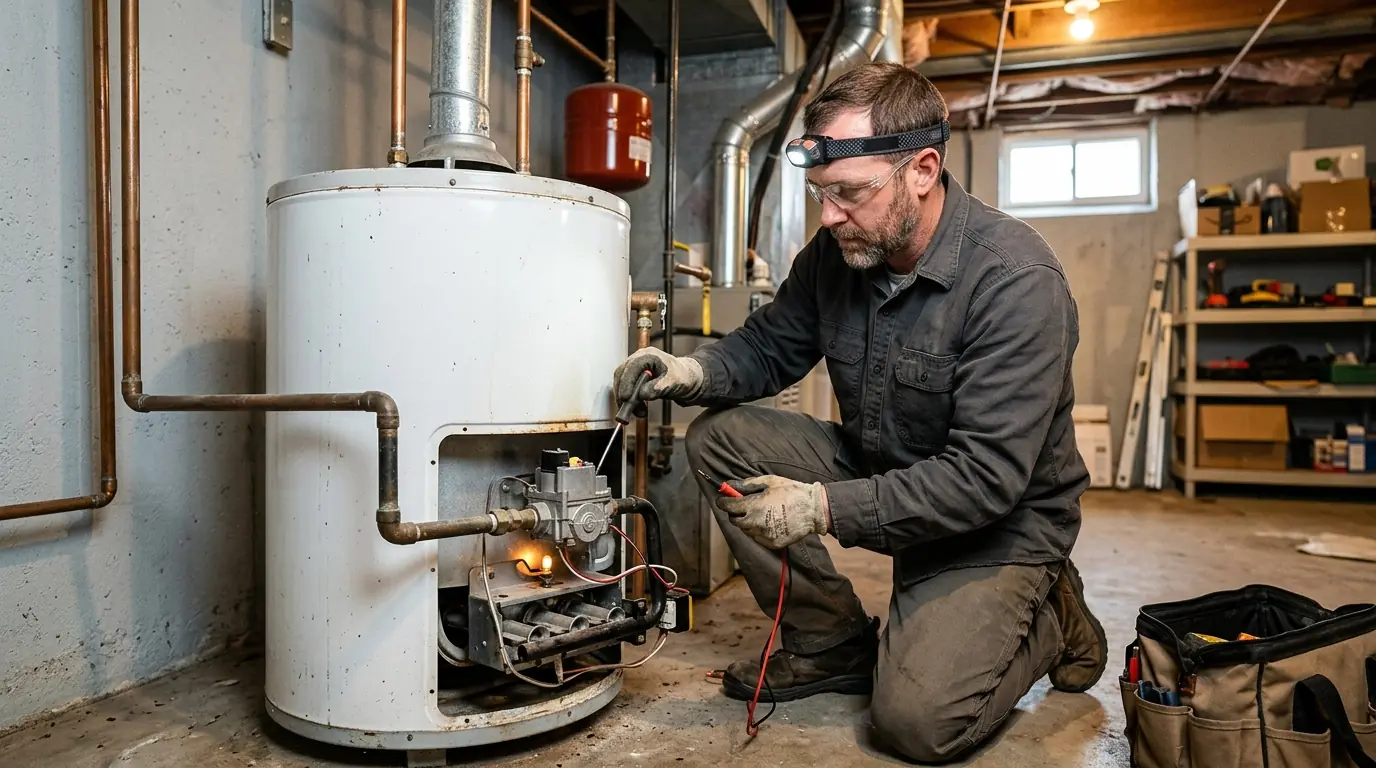
- Testing the thermostat, thermocouple, or igniter under load
- Inspecting the burner assembly and flame pattern
- Checking the anode rod where access allows
- Measuring recovery time against the unit rating
- Verifying the temperature and pressure relief valve operates
- Inspecting the flue and draft on atmospheric units
- Flushing sediment where the tank condition allows it safely
- A written verdict on repair against replacement
What you get
What changes after the visit
Repair gets considered before replacement
Thermostats, thermocouples, igniters, and valves are stocked items with short fixes.
The scale problem gets named
Flushing and anode replacement extend service life rather than treating symptoms.
Venting is checked, not assumed
Backdrafting on an atmospheric unit is a safety issue, and it gets inspected on every visit.
You hear the honest verdict
When a nine year old tank is weeping at the seam, we say replace rather than sell you a repair.
Warranty status gets checked
Many tanks still carry manufacturer coverage on parts that owners assume expired.
Handling it yourself against calling us
| Factor | Doing it yourself | Calling us |
|---|---|---|
| Diagnosing no hot water | Guessing between the element and the thermostat | Meter testing that identifies the failed component |
| Gas units | Working near an open gas valve without leak detection | Combustion and draft verified before the unit is relit |
| Flushing | Opening a drain valve that may not close again | Tank condition assessed first, valve replaced if needed |
| Anode replacement | A rod that will not clear a low ceiling | Segmented rods where headroom is short |
| Relief valve discharge | Capping or plugging the outlet | Diagnosing the pressure or temperature cause behind it |
Denver rules and local conditions that apply
Denver requires permits on water heater replacement but not on component repair, which is one reason the repair against replacement decision is worth taking seriously rather than defaulting to a new tank.
Combustion air and venting rules matter in older Denver homes where a heater shares a flue with a furnace. Replacing one appliance can leave the other improperly vented, and that interaction gets checked rather than ignored.
Budgeting
What moves the price up or down
Which part failed
A thermocouple sits at the low end; a gas control valve sits considerably higher.
Fuel type
Electric elements are generally cheaper to replace than gas control assemblies.
Access
Tanks wedged into crawl spaces or narrow closets add labor before the repair starts.
Tank age
Past roughly ten years on Denver water, repair money is often better spent toward replacement.
Parts availability
Common Rheem and A.O. Smith components are stocked; obscure imports may need ordering.
Why this crew
Why homeowners call us back
One point of accountability
The technician who diagnoses the problem stands behind the repair.
Built for Front Range conditions
Hard water, expansive clay, and a deep frost line shape every recommendation.
Priced before work starts
Written figures, no hourly surprises, and a straight answer on the cheaper path.
Old systems taken seriously
Prewar boilers, cast iron stacks, and clay laterals get repaired where repair is honest.
Common questions
Questions we field on this work
Sometimes. If the tank is sound and the failure is a control component, a repair can add several years. If the anode is long gone and the seam is weeping, replacement is the honest answer.
Sediment takes up volume that used to hold water. A tank carrying several inches of scale delivers noticeably less hot water than its rating suggests.
Water trapped under a hardened scale layer flashing to steam. It signals a flush is overdue, and on older tanks it signals the scale is already cemented.
Once a year on this water. Homes without a softener may benefit from more frequent attention, particularly in Brighton and the north metro.
No. That valve is the safety device that prevents a tank rupture. Repeated discharge means pressure or temperature needs diagnosis.
Yes. Descaling and fault diagnosis on Navien and Rinnai equipment is covered under tankless work.
Often, if the anode is replaced before the tank steel has lost significant material. Once rust is heavy the tank is usually past saving.
A leak at a fitting or valve is repairable. A leak through the tank wall is not, because the inner shell has corroded through.
Common thermocouples, elements, thermostats, and relief valves are stocked, so many repairs finish on the first visit.
Find out whether repair still makes sense
We test the unit, price both paths, and tell you which one we would choose.