Sewer Camera Inspection in Denver, CO
About to buy a Denver house, or tired of clearing the same lateral? A camera run puts the pipe material, every defect, and the depth on record, which is the difference between guessing at a repair bill and knowing one.
Quick answer
What does a sewer camera inspection show in Denver?
A Denver sewer camera inspection identifies the pipe material, locates every defect along the lateral with a depth and distance reading, and records the condition to the city main. On pre-1970s properties it commonly finds clay joint separation, root intrusion, or Orangeburg deformation before those become a backup.
Updated August 2026 by Colton Brackett, Lead Plumber
What this work actually covers
A sewer lateral is the one pipe in a house with no redundancy and no visible surface. Everything else can be inspected by looking at it. The lateral runs six to twelve feet under the yard, and until a camera goes down it, every statement about its condition is an assumption.
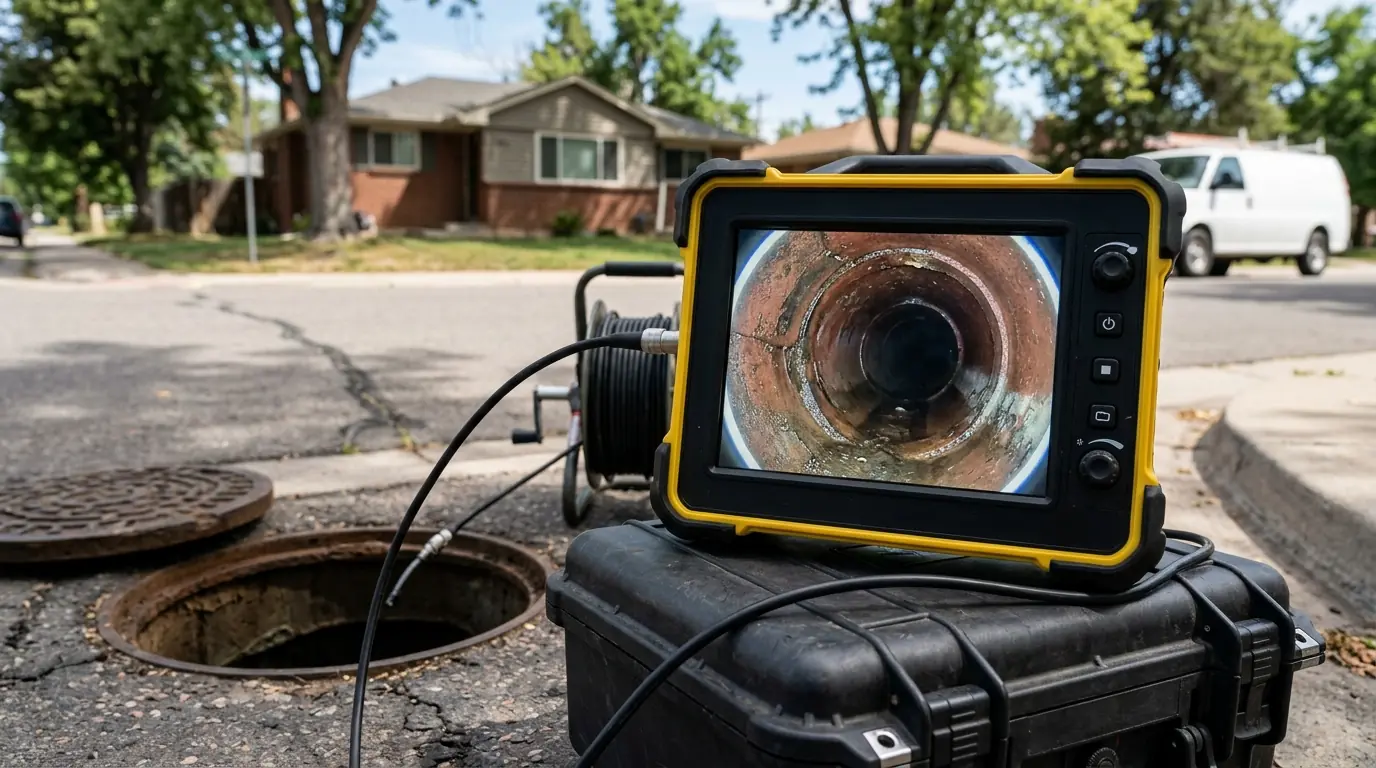
The inspection itself is straightforward. A self levelling camera head on a flexible rod feeds from the cleanout toward the city main while the operator watches the feed. A sonde in the head transmits a signal that a locator picks up at the surface, so any defect gets a mark on the ground and a depth reading.
The value is not the footage. It is the decision the footage makes possible: whether you are looking at annual maintenance, a spot repair on two joints, lining, or full replacement. Those four outcomes differ by an order of magnitude in cost.
The detail that matters
What actually goes wrong, and why here
Pipe material is the first thing the operator identifies, because it predicts everything that follows. Clay shows as segmented sections with visible joints roughly every two to five feet, and those joints are where failure concentrates. Cast iron appears continuous with a rougher, often tuberculated interior. Orangeburg looks like dark fibrous material and frequently shows an oval bore rather than a round one.
Defects then get categorised by consequence rather than by appearance. Root hair passing through a joint is maintenance. A root mass filling the bore is a repair. An offset joint where one section has dropped below the next is structural. Soil visible inside the pipe means ground is migrating in, and the surface above it will eventually settle.
Standing water is the finding people most often misread. A short stretch of water in an otherwise sound line usually indicates a belly, where bedding settled and the pipe lost its fall. A belly does not leak, so it never causes the alarm a crack does, yet it collects solids indefinitely and is the reason some lines block every year despite thorough jetting.
What you get
What changes after the visit
You see the pipe rather than a description
Footage removes the trust gap on a repair nobody can otherwise verify.
Defects get a location and a depth
Marked positions mean excavation is targeted rather than exploratory.
Repair options become comparable
Knowing how much sound pipe remains is what separates lining from replacement.
Negotiating position before purchase
A documented defect is a number a seller can be asked to address.
Baseline for the future
A recording taken now makes any later change measurable rather than debatable.
What an inspection covers
- Locating and opening a usable cleanout access
- Camera run from the building to the city main connection
- Pipe material identified and reported
- Every defect noted with distance from the access point
- Sonde locating with depth marked at the surface
- Standing water and grade problems recorded
- Recorded footage supplied to you
- A written summary of findings and the repair options they imply
Warning signs
Signs the problem is already under way
Clearing needed more than once a year
Short intervals almost always indicate a defect rather than household habits.
A property built before 1975
Clay and Orangeburg dominate that era in Denver, and both have known failure modes.
Large trees standing over the run
Elm and cottonwood roots are the primary cause of joint intrusion in this city.
A house you are about to buy
Lateral condition is rarely covered by a standard home inspection, and the repair lands on the buyer.
Unexplained wet ground along the line
Effluent escaping a break shows at the surface before it shows in the house.
Any quote for excavation without footage
No contractor should be pricing a dig without having seen the pipe.
Buying a Denver home built before 1975?
The lateral is excluded from most purchase inspections, and it is the most expensive thing under that yard.
Call (720) 698-9746Brands We Service
- Rheem
- A.O. Smith
- Bradford White
- Navien
- Rinnai
- Weil-McLain
- Burnham
- Moen
- Kohler
- Zoeller
How long the work takes
A standard residential inspection takes forty five minutes to an hour and a half depending on lateral length and how readily the camera travels. Locating and surface marking adds time where a defect is found.
Where the line is blocked, clearing has to happen before the camera can pass. That is separate work and is quoted before it begins rather than added to the invoice afterward.
What happens after you call
The access point is opened
A cleanout at the foundation or in the basement gives the cleanest entry to the run.
The camera travels to the main
The full lateral is viewed rather than the first accessible stretch.
Defects are logged by distance
Each finding is recorded against its distance from the access point.
The sonde is located at the surface
Depth and position are marked on the ground where excavation would occur.
Findings and footage are handed over
You keep the recording and receive a written summary of what it means.
Denver rules and local conditions that apply
Denver property owners own the lateral to the city main, including under the street, so the inspection covers the full extent of what you are responsible for.
Standard residential purchase inspections in Colorado do not include the sewer lateral. On any pre-1975 Denver property that omission is the single most expensive gap in the report.
Handling it yourself against calling us
| Factor | Doing it yourself | Calling us |
|---|---|---|
| Knowing pipe condition | Assuming it is fine because it drains | Material and defects recorded on footage |
| Before buying a house | Trusting a standard home inspection | Lateral inspected separately, because most inspections exclude it |
| Pricing a repair | Accepting an estimate with no evidence | Defect located with depth, so the quote reflects real scope |
| Recurring blockages | Clearing again and hoping | Cause identified so the cycle can be ended |
| Documentation | A verbal account of what was found | Footage and a written summary you keep |
Budgeting
What moves the price up or down
Access availability
A usable cleanout keeps it simple; a buried or missing one adds work before the camera enters.
Length of the run
Deep lots with long laterals take more time than a short run to the street.
Locating requirement
Sonde locating with surface marking is additional to a straight visual pass.
Line condition
A blocked line may need clearing before the camera can travel, which is separate work.
Turnaround on documentation
Same visit verbal findings are standard; written reports for a purchase file take longer.
Why this crew
Why homeowners call us back
One point of accountability
The technician who diagnoses the problem stands behind the repair.
Built for Front Range conditions
Hard water, expansive clay, and a deep frost line shape every recommendation.
Priced before work starts
Written figures, no hourly surprises, and a straight answer on the cheaper path.
Old systems taken seriously
Prewar boilers, cast iron stacks, and clay laterals get repaired where repair is honest.
Common questions
Questions we field on this work
On any Denver property built before 1975, yes. Lateral repair is a five figure risk that a standard inspection does not cover.
Usually under ninety minutes for a residential run, plus additional time if locating and surface marking are needed.
Yes. The recording is yours, which matters if you are negotiating a purchase or comparing repair quotes.
No. The blockage has to be cleared first, and that is quoted as separate work before it starts.
You get the footage, the location, and the options priced honestly, from a spot repair through to replacement.
No. The head is small and flexible and applies far less force than a cable does.
A transmitter in the camera head is tracked from the surface with a locator, which reads both position and depth.
It usually indicates a belly where bedding settled. It will not leak, but it collects solids and causes repeat blockages.
Not necessarily, though on an older property with mature trees it is cheap insurance against a surprise.
Put the lateral on record before you spend
Footage, a marked location, and a written summary you can act on.