Slab Leak Repair in Denver, CO
A warm patch on the floor, or water use that does not match anything you are doing? Slab leaks hide under concrete and announce themselves indirectly. We locate the position acoustically before any concrete gets cut.
Quick answer
What is a slab leak and how serious is it in Denver?
A slab leak is a break in a supply line running beneath or within a concrete floor slab. In Denver the expansive clay soil under many 1950s to 1970s tracts compounds it, because escaping water swells the ground and lifts the slab unevenly. Left running it moves from a plumbing repair toward a foundation problem.
Updated August 2026 by Colton Brackett, Lead Plumber
What this work actually covers
Slab construction places supply lines in or under the concrete floor, which means a failure there is invisible and the water has nowhere obvious to go. It saturates the sub base instead, and in Denver that sub base is frequently expansive clay that swells when wet.
That soil behaviour is what makes slab leaks more consequential here than in many markets. A leak releasing steadily under one corner of a house raises moisture content in the clay beneath it, the clay expands, and the slab lifts unevenly. Doors that stop closing and cracks appearing in drywall are sometimes the first noticed symptom.
The good news is that location technology is genuinely good. Acoustic equipment reads escaping water through concrete accurately enough to narrow a cut to a small area, and in many cases the better answer avoids cutting altogether.
Warning signs
Signs the problem is already under way
A warm spot on the floor
A leaking hot supply line heats the concrete above it, and this is the classic first sign.
Water use climbing without explanation
Continuous loss under a slab shows on the bill before it shows anywhere else.
Sound of running water with taps closed
Escaping water is audible through concrete in a quiet house.
Cracks appearing in drywall or flooring
Slab movement from saturated clay transfers into the finishes above.
Doors and windows sticking suddenly
Uneven slab lift changes frame geometry before anything visibly fails.
Damp or discolored flooring at an edge
Moisture reaching a slab perimeter surfaces at the edge of the finish.
What happens after you call
Loss is confirmed at the meter
Rate of loss establishes urgency and helps distinguish supply from drain sources.
Hot and cold loops are isolated
Pressure testing identifies which loop is leaking before any location work begins.
The position is located acoustically
Listening equipment narrows the source to a small marked area on the floor.
Options are priced side by side
Spot repair, reroute, and repipe each get a figure and the reasoning behind it.
The chosen work is completed and tested
Pressure is held before concrete is closed, and the floor is patched ready for finish.
How long the work takes
Location typically takes two to three hours. A spot repair through a slab usually completes within a day once the position is known, including patching the concrete.
Rerouting a failed run takes longer, commonly one to two days depending on the path available, but it removes the failure mode rather than resetting the clock on it.
The detail that matters
What actually goes wrong, and why here
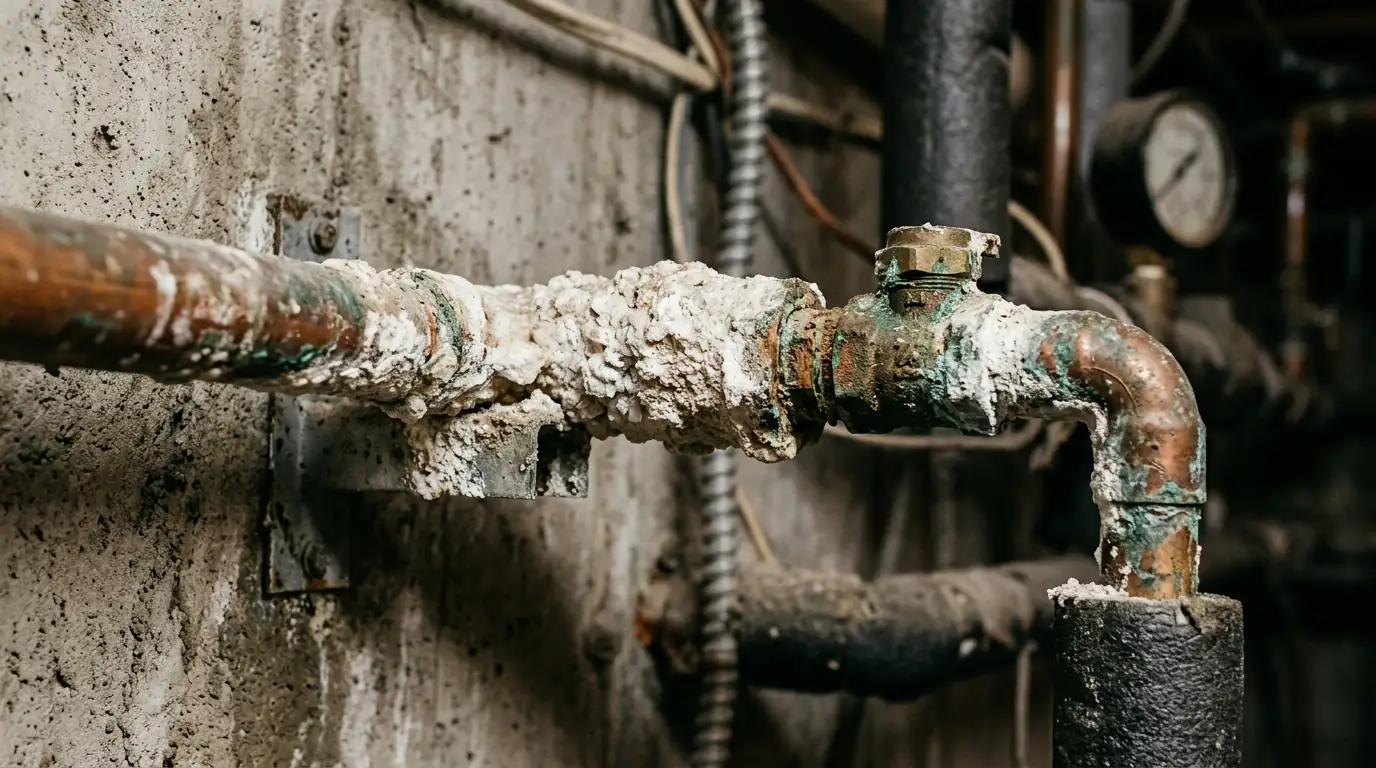
Copper in concrete fails for reasons that are worth understanding before choosing a repair. Concrete is alkaline and copper is generally comfortable in it, but movement is the problem. Every thermal cycle expands and contracts the pipe against the surrounding concrete, and where a line crosses a control joint or lacks a sleeve, that abrasion thins the wall until it perforates.
This matters because it predicts recurrence. A pinhole caused by abrasion at one crossing point tells you the same conditions exist wherever else that loop crosses concrete. Repairing the single hole is legitimate and sometimes correct, but on an original loop that has begun failing, a second leak within a couple of years is common.
That is why rerouting deserves serious consideration rather than treatment as a last resort. Abandoning the buried run and routing new line through the attic or along walls removes the failure mode permanently, avoids repeated concrete work, and on a house that has already had one slab leak it frequently costs less over five years than the alternative. Where a whole system is involved, full repiping becomes the comparison to make.
Warm patch on the floor that was not there last year?
That is the classic slab leak signature, and the clay under a Denver foundation makes waiting expensive.
Call (720) 698-9746Brands We Service
- Rheem
- A.O. Smith
- Bradford White
- Navien
- Rinnai
- Weil-McLain
- Burnham
- Moen
- Kohler
- Zoeller
What a slab leak visit covers
- Meter observation to confirm and rate the loss
- Pressure isolation separating hot and cold supply loops
- Acoustic and thermal location through the slab
- The position marked precisely on the floor surface
- Repair, reroute, and repipe options priced against each other
- Concrete opened only at the located point where cutting is chosen
- Repair pressure tested before the slab is closed
- Concrete patched and the floor made ready for finish restoration
What you get
What changes after the visit
The leak is positioned before any cut
Acoustic location turns a wide excavation into a small opening.
Rerouting is considered honestly
Abandoning a failed run and routing overhead often costs less than repeated slab work.
Soil movement risk gets addressed
Stopping the water is what stops the clay swelling under the foundation.
The rest of the system is assessed
One failure in an original copper slab loop is information about the whole loop.
Documentation for insurance
Access costs are covered by many policies, and the findings support the claim.
Handling it yourself against calling us
| Factor | Doing it yourself | Calling us |
|---|---|---|
| Locating | Cutting concrete where the floor feels warm | Acoustic and pressure isolation narrow it to a small area |
| Repair approach | Cutting and patching each failure as it appears | Repair against reroute compared on five year cost |
| Recurrence | Waiting for the next pinhole in the same loop | Loop condition assessed so the pattern is understood |
| Soil movement | Leaving water in the clay under the foundation | Loss stopped promptly to limit swelling |
| Insurance | Paying access costs unclaimed | Documented findings supporting the access coverage most policies carry |
Denver rules and local conditions that apply
Expansive bentonite clay underlies large areas of the Denver metro, and it is the reason a slab leak here carries foundation implications that the same leak elsewhere would not.
Slab construction is common in tracts built from the 1950s onward across Virginia Village, Harvey Park, and Montbello, where original copper supply loops are now well past the age at which abrasion failures begin.
Budgeting
What moves the price up or down
Depth and thickness of the slab
Thicker concrete and post tension construction both add complexity to any cut.
Floor finish above the leak
Tile, hardwood, and polished concrete all carry restoration cost beyond the plumbing.
Repair against reroute
Rerouting costs more up front and frequently less across the following years.
How many failures the loop has had
A first pinhole and a third pinhole justify different decisions.
Access from the perimeter
Some slab runs can be reached from outside the foundation, which avoids interior work entirely.
Why this crew
Why homeowners call us back
One point of accountability
The technician who diagnoses the problem stands behind the repair.
Built for Front Range conditions
Hard water, expansive clay, and a deep frost line shape every recommendation.
Priced before work starts
Written figures, no hourly surprises, and a straight answer on the cheaper path.
Old systems taken seriously
Prewar boilers, cast iron stacks, and clay laterals get repaired where repair is honest.
Common questions
Questions we field on this work
A warm patch on the floor, unexplained water use, or the sound of running water with everything closed. The meter test confirms it quickly.
Not always. Where rerouting is viable the buried run is abandoned instead, which avoids concrete work entirely.
On a loop that has already failed once, frequently yes. It costs more now and usually less across five years.
In Denver it can. Water swells the clay beneath the slab and lifts it unevenly, which is why prompt action matters here.
Many policies cover the cost of accessing the leak and the resulting damage while excluding the pipe itself. Documented findings support the claim.
Acoustic equipment typically narrows it to a small area, which is the difference between a modest patch and a demolished floor.
Usually abrasion where the line moves against concrete through thermal cycles, particularly at joints and crossings.
On the same loop, yes, because the conditions that caused it exist wherever else the run crosses concrete.
The tile above the cut will not survive. That restoration cost is part of why rerouting often wins on tiled floors.
Locate it before anyone cuts concrete
Acoustic positioning first, then repair and reroute priced against each other.