Sewer Line Repair in Denver, CO
Backing up again after the last clearing held for a month? Repeat backups mean the lateral has a defect rather than a habit problem. We camera and locate it, then price the repair against the section that actually failed.
Quick answer
What causes sewer line failure in Denver homes?
Denver sewer laterals fail mainly at joints. Expansive bentonite clay soil swells and shrinks with moisture, pulling mortared clay pipe joints apart, and elm and cottonwood roots follow the released moisture into the gap. Homes built before the 1970s carry the highest risk because clay and Orangeburg pipe dominate that era.
Updated August 2026 by Colton Brackett, Lead Plumber
What this work actually covers
A sewer lateral is the single pipe carrying everything the house drains out to the city main, and in Denver the homeowner owns all of it, including the run beneath the street. There is no redundancy in that pipe, so a defect anywhere along it affects every fixture in the building.
Failures cluster into four types. Root intrusion enters at a joint and expands until it traps solids. A belly or sag holds standing water that collects debris. A crack or offset joint lets soil in and effluent out. A full collapse stops flow entirely and usually announces itself as a backup that will not clear.
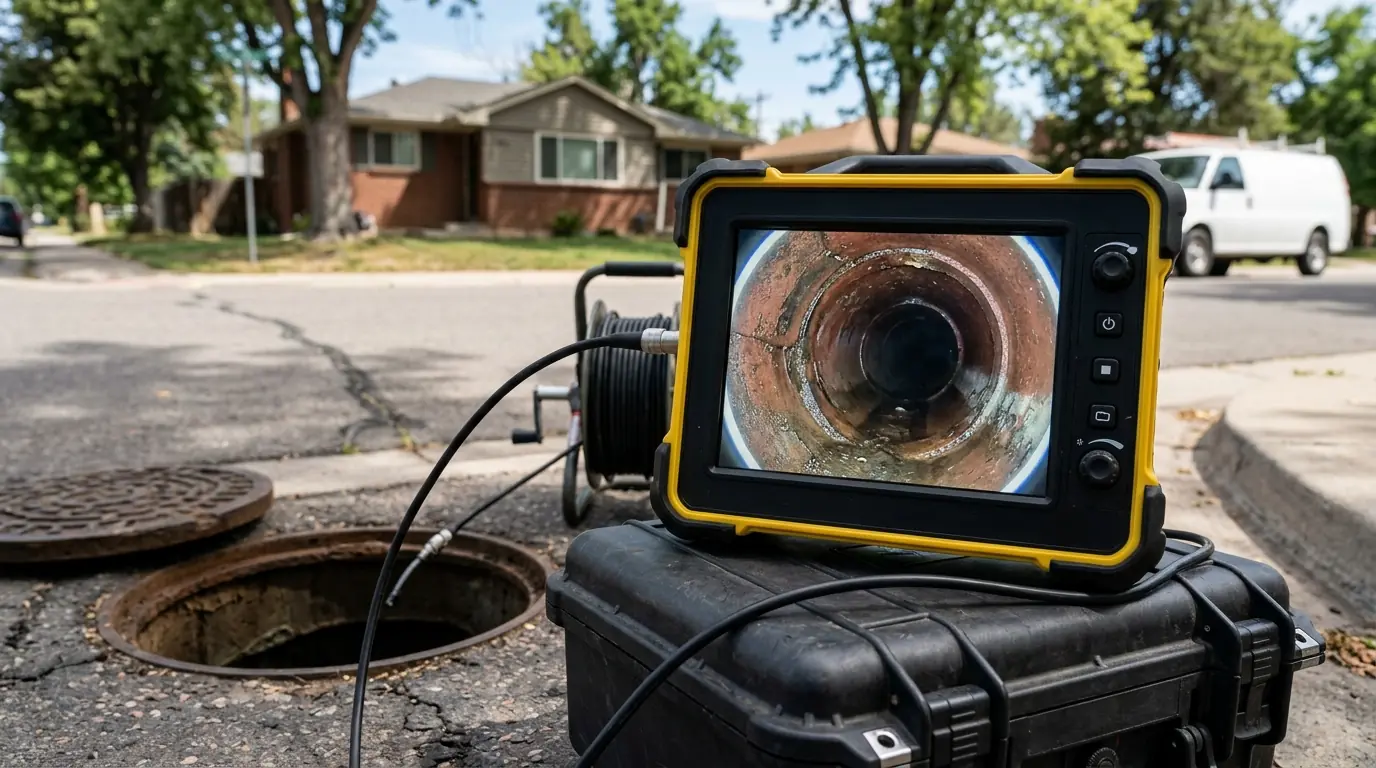
Which one you have decides everything about the repair, and no amount of clearing tells you. That answer comes from a camera run with a locator, which puts a depth and a distance on the defect before anyone quotes excavation.
Warning signs
Signs the problem is already under way
Backups returning within months of clearing
Short intervals point at a defect rather than at accumulation.
Patches of unusually green grass over the run
Effluent escaping a cracked joint fertilizes the soil above it.
A depression forming in the yard
Soil migrating into a broken pipe leaves a void that settles at the surface.
Sewage odor outdoors near the line
Gas escaping through a break rather than venting through the roof.
Rodent activity in the basement
Rats travel sewer laterals and enter buildings through breaks in the pipe.
Multiple fixtures gurgling together
Shared line restriction, which on a lateral usually means a structural defect.
What happens after you call
The full lateral is inspected on camera
The whole run to the main gets viewed, not just the section nearest the cleanout.
The defect is located and marked
A locator puts depth and distance on the surface so excavation is precise.
You see the options priced honestly
Spot repair, lining, and replacement each get a figure and a plain explanation.
Permit and utility locates are arranged
Denver permitting and underground utility marking happen before any digging.
The repair is completed and re-inspected
A second camera pass confirms the fix, and the surface is restored to grade.
How long the work takes
A located spot repair on a lateral at typical Denver depth generally takes one to two days including excavation, repair, backfill, and inspection. Trenchless lining of a single section is often completed in a day.
Permit processing and utility locates usually add several days before work begins. Emergency clearing can hold the property in the meantime so the household is not without drainage.
The detail that matters
What actually goes wrong, and why here
Orangeburg pipe deserves specific mention because Denver has a lot of it. Manufactured from wood pulp and pitch, it was installed widely in the postwar decades and was never intended to last this long. It deforms under soil load rather than cracking, so the bore goes oval and then closes. Orangeburg is not repairable in any meaningful sense, and a camera identifies it instantly.
Clay behaves differently. The pipe material itself is durable and frequently sound after a century, but the mortared joints between sections are not. Expansive soil movement opens them a few millimetres, roots find the moisture, and the joint becomes an entry point. On a line where only two or three joints have failed, spot repairs are genuinely the right call.
The decision between spot repair, lining, and full replacement comes down to how many defects exist and how much sound host pipe remains between them. That is why the camera and locator run matters more than any estimate given over the phone, and why the inspection is the first step rather than an upsell.
Third backup this year on the same line?
Repeat failures at short intervals are a defect announcing itself. A camera run puts a location and a price on it.
Call (720) 698-9746Brands We Service
- Rheem
- A.O. Smith
- Bradford White
- Navien
- Rinnai
- Weil-McLain
- Burnham
- Moen
- Kohler
- Zoeller
What a sewer repair covers
- Camera inspection of the full lateral to the city main
- Electronic locating with depth and distance marked at the surface
- Utility locate requested before any excavation begins
- A written repair plan with the alternatives priced
- Denver permit pulled and inspection coordinated
- Excavation limited to the located defect where possible
- Replacement section joined to sound host pipe correctly
- Backfill, compaction, and surface restoration to grade
What you get
What changes after the visit
The defect is located before quoting
Depth and distance are known, so excavation is targeted rather than exploratory.
You pay to repair what failed
A spot repair on a sound line costs a fraction of full replacement.
Trenchless options get considered
Where the host pipe allows it, lining avoids most of the yard damage.
Permits and inspection are handled
Denver requires them on lateral work, and we manage the process.
The rest of the line gets assessed
Knowing the condition of the remaining run prevents repairing one joint ahead of three more.
Handling it yourself against calling us
| Factor | Doing it yourself | Calling us |
|---|---|---|
| Finding the defect | Digging where the yard looks wet | Camera and locator mark depth and distance first |
| Repeat backups | Clearing again every few months | The defect repaired so the cycle ends |
| Orangeburg pipe | Attempting a patch on material that cannot hold one | Identified on camera and replaced or lined |
| Permits | Unpermitted work that surfaces at resale | Pulled and inspected as part of the job |
| Yard damage | Exploratory trenching across the lawn | Targeted excavation, or trenchless where the host pipe allows |
Denver rules and local conditions that apply
Denver property owners are responsible for the sewer lateral from the building to the city main, including the portion under the street and sidewalk. Work in the public right of way requires additional permitting beyond the plumbing permit.
Utility locates must be requested before excavation. Gas, electric, and communications lines frequently cross a lateral run, and striking one converts a plumbing job into a far more serious incident.
Budgeting
What moves the price up or down
Depth of the line
Denver laterals commonly run six to twelve feet down, and depth drives excavation cost sharply.
Length of the failed section
One bad joint is a spot repair; three across forty feet changes the calculation.
What sits above the run
Driveways, mature trees, and hardscape all add restoration cost after the repair.
Pipe material
Sound clay accepts a spot repair; Orangeburg and heavily deteriorated pipe generally do not.
Permit and inspection fees
Denver charges these directly and they pass through at actual cost.
Why this crew
Why homeowners call us back
One point of accountability
The technician who diagnoses the problem stands behind the repair.
Built for Front Range conditions
Hard water, expansive clay, and a deep frost line shape every recommendation.
Priced before work starts
Written figures, no hourly surprises, and a straight answer on the cheaper path.
Old systems taken seriously
Prewar boilers, cast iron stacks, and clay laterals get repaired where repair is honest.
Common questions
Questions we field on this work
The camera answers it. A line with two failed joints and sound pipe between them is a repair candidate. A line with defects throughout is not.
Not always. Where the host pipe is sound enough, lining avoids most excavation. The camera determines whether that is viable.
Wood pulp and pitch pipe installed widely in the postwar decades. It deforms rather than cracks and is not repairable, so it gets replaced or lined.
Usually not for the pipe itself, though resulting water damage is sometimes covered. Service line endorsements exist and are worth checking.
Denver assigns lateral ownership to the property owner all the way to the main, which surprises most homeowners the first time it matters.
Commonly six to twelve feet, which is why depth is one of the largest cost drivers on any excavation.
Only by removing the entry point. Repairing or lining the joint stops intrusion; cutting does not.
Yes. Denver permits lateral work and inspects it, and we coordinate that rather than leaving it to you.
Backfill is compacted and the surface restored to grade. Full turf recovery takes a season regardless of who does the work.
Find the defect before paying to dig
Camera and locator first, then a repair priced against what actually failed.