Tankless Water Heater Installation in Denver, CO
Thinking about going tankless, but unsure whether this house can support it? Gas supply, venting route, and Denver water hardness decide whether tankless is a good investment here, and we assess all three before quoting anything.
Quick answer
Does a tankless water heater make sense in Denver?
Tankless water heaters work well in Denver when the home has adequate gas supply, usually a three quarter inch line or larger, and a viable route for sealed venting. Hard Front Range water means descaling every twelve to eighteen months is mandatory rather than optional, and that ongoing requirement should factor into the decision.
Updated August 2026 by Colton Brackett, Lead Plumber
What this work actually covers
A tankless unit heats water as it passes through rather than storing it, which removes standby loss and the possibility of running out mid shower. Those two advantages are real, and for the right household they justify the cost. The complication is that a tankless heater asks considerably more of the house than a tank does.
Gas demand is the first hurdle. A storage tank might draw forty thousand BTU. A whole house tankless unit commonly draws a hundred and eighty thousand or more, and that flow has to arrive through pipe that was often sized decades ago for far less. Upsizing the gas line from the meter is a frequent and unavoidable part of the quote.
Venting is the second. These units require sealed stainless or polypropylene venting rather than the existing chimney, and the route has to reach an exterior wall or roof within manufacturer limits. In a finished Denver basement that route is sometimes straightforward and sometimes the reason the project does not pencil.
Budgeting
What moves the price up or down
Gas line upgrade
Frequently the single largest line item, and it depends on distance from the meter.
Venting route length
Long runs and multiple turns add material and labor over a short exterior wall penetration.
Unit flow rating
Higher flow models cost more and are genuinely necessary in multi bathroom households.
Condensate handling
Condensing units need drainage and sometimes neutralization, which adds work in finished spaces.
Recirculation
Adding a loop or buffer for faster delivery is optional and priced separately.
Handling it yourself against calling us
| Factor | Doing it yourself | Calling us |
|---|---|---|
| Gas capacity | Assuming the existing line is adequate | Load calculated across all appliances before quoting |
| Venting | Reusing the chimney the tank vented into | Sealed venting routed within manufacturer limits |
| Descaling | Discovering fault codes two years later | Isolation valves fitted and a schedule agreed at install |
| Sizing | Choosing on capacity marketing | Flow rate matched to simultaneous fixture demand |
| Permits | Unpermitted work that surfaces at resale | Pulled and inspected as part of the job |
What the installation covers
- Gas load calculation across every appliance in the house
- Gas line upsizing from the meter where the calculation requires it
- Sealed venting routed within manufacturer length and turn limits
- Condensate drainage and neutralization where required
- Isolation valves fitted so future descaling is straightforward
- Unit mounted, connected, and commissioned to manufacturer spec
- Denver permit pulled and inspection coordinated
- A descaling schedule set out in writing before we leave
The detail that matters
What actually goes wrong, and why here
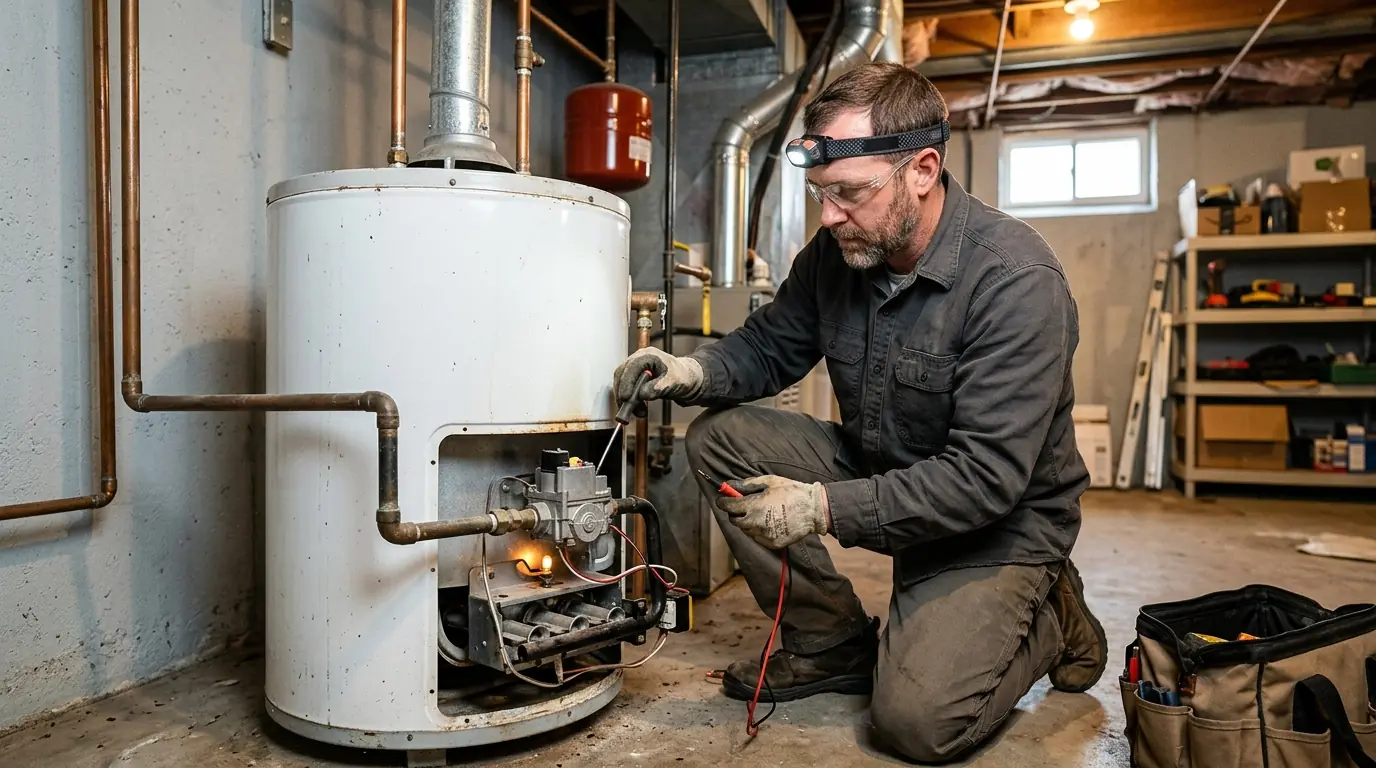
The honest tradeoff with tankless in Denver is maintenance. A Navien or Rinnai heat exchanger passes water through narrow passages at high temperature, which is exactly the condition that deposits scale fastest. On untreated Front Range water these units begin throwing flow and temperature faults within a couple of years if nobody descales them. That service is not difficult, but it is recurring, and it belongs in the cost comparison rather than in the fine print.
The second consideration is the cold water sandwich. Between draws the unit stops firing, so a short pause in flow sends a slug of unheated water down the line before the burner catches again. Modern units buffer this well and a small recirculation buffer removes it entirely, but a household that fills a tub in stages will notice it on a basic install.
For many Denver houses the right answer turns out to be a high recovery tank rather than tankless, particularly where the gas upgrade and venting route push the project cost past what the fuel savings recover. We run that comparison honestly, including the case where a conventional tank is the better purchase.
Not sure whether this house can support tankless?
The gas line and the venting route decide it. Both can be checked in a single visit before you commit to anything.
Call (720) 698-9746Brands We Service
- Rheem
- A.O. Smith
- Bradford White
- Navien
- Rinnai
- Weil-McLain
- Burnham
- Moen
- Kohler
- Zoeller
What you get
What changes after the visit
Hot water does not run out
Continuous heating removes the tank capacity limit entirely.
Standby loss disappears
No stored volume means no fuel spent keeping water hot overnight.
Floor space is recovered
A wall mounted unit frees the footprint a tank occupied.
Service life is longer when maintained
Heat exchangers commonly outlast tanks substantially, provided descaling actually happens.
Leak risk drops
There is no stored volume to release when a component fails.
Denver rules and local conditions that apply
Denver permits tankless installation and inspects gas sizing, venting, and condensate handling. Altitude derating applies here as it does to any gas appliance above five thousand feet.
Manufacturer warranties on these units typically require documented descaling. Skipping it does not just shorten service life, it can void the coverage that justified the purchase.
What happens after you call
We assess the house before quoting
Gas capacity, venting routes, electrical supply, and fixture demand get measured rather than assumed.
You see the honest comparison
Tankless against a high recovery tank, including the descaling commitment and the payback math.
A written quote covers everything
Gas work, venting, condensate, permit, and unit are itemized so nothing appears later.
Installation and commissioning
The unit is mounted, connected, vented, and set up to manufacturer specification.
Descaling is scheduled, not mentioned
Isolation valves go in and the maintenance interval is written down before we leave.
How long the work takes
A tankless install in a house that already has adequate gas supply and a short venting route usually completes in one day. Projects requiring gas line replacement from the meter or long vent runs through finished space commonly run two.
Permit processing runs alongside the work, and the inspection is coordinated afterward rather than left to you.
Warning signs
Signs the problem is already under way
The gas line is half inch from the meter
Whole house tankless demand rarely fits through undersized supply without upgrade.
No exterior wall near the unit location
Sealed venting has length and turn limits that a deep basement location can exceed.
No softener on hard water
Untreated Denver water scales a heat exchanger faster than most owners expect.
Long distance to the farthest fixture
Wait times at a remote bathroom can get worse rather than better without a recirculation loop.
Simultaneous demand across several bathrooms
Flow rate, not capacity, becomes the limit, and undersizing shows up immediately.
Electrical supply missing at the location
Even gas units need power for ignition and controls, which older utility spaces sometimes lack.
Tankless Water Heater Installation coverage by ZIP code
Why this crew
Why homeowners call us back
One point of accountability
The technician who diagnoses the problem stands behind the repair.
Built for Front Range conditions
Hard water, expansive clay, and a deep frost line shape every recommendation.
Priced before work starts
Written figures, no hourly surprises, and a straight answer on the cheaper path.
Old systems taken seriously
Prewar boilers, cast iron stacks, and clay laterals get repaired where repair is honest.
Common questions
Questions we field on this work
On fuel, modestly, by removing standby loss. Whether the total project recovers its cost depends heavily on whether your gas line needs replacing.
Every twelve to eighteen months on Denver water. With a softener the interval stretches, but it never disappears.
Only where sealed venting can reach an exterior wall or roof within manufacturer length and turn limits.
Frequently yes. Whole house units draw several times what a tank does, and older half inch supply rarely carries it.
A brief slug of unheated water when flow restarts after a short pause. Modern units minimize it and a buffer removes it.
Navien and Rinnai primarily, because both have strong parts availability and serviceability in the metro.
No. Where the gas upgrade and venting route are expensive, a high recovery tank is often the better purchase, and we say so.
No. Gas tankless units need electricity for ignition and controls.
Yes, for large households or simultaneous high demand, though it raises both the gas requirement and the cost.
Find out whether tankless fits your house
We assess capacity, run the comparison honestly, and quote the real total.