Water Heater Installation in Denver, CO
Ready to replace a tank rather than patch it again? We size the new unit to how your household actually uses hot water, handle the Denver permit, and correct the venting and expansion issues older installs frequently left behind.
Quick answer
What does water heater installation involve in Denver?
Water heater installation in Denver takes roughly three to five hours and requires a permit from Community Planning and Development. The work covers draining and removing the old tank, correcting venting and expansion control to current code, setting and connecting the new unit, and verifying combustion before the crew leaves.
Updated August 2026 by Colton Brackett, Lead Plumber
What this work actually covers
Replacing a water heater looks like swapping one cylinder for another. In practice most of the cost and nearly all of the risk sits in the connections around it: the gas line, the flue, the expansion tank, the seismic strapping, and the drain pan. Denver code has moved several times over the decades, so a tank installed in 1998 is frequently not compliant with what applies today.
Sizing is the other half of the decision. A forty gallon tank that served a couple comfortably will disappoint a family of five with two teenagers, and oversizing wastes standby energy on a fuel bill that runs all year. First hour rating matters more than raw capacity, and that number depends on burner input as much as tank volume.
The brands worth considering here are the ones with parts availability in the metro. Rheem, A.O. Smith, and Bradford White cover most installs, and their components sit on supply house shelves rather than arriving by freight a week later.
Budgeting
What moves the price up or down
Tank capacity and efficiency
Higher first hour ratings and better insulation carry higher equipment cost but lower running cost.
Fuel type
Gas installs involve combustion and venting work that electric installs do not.
Code corrections needed
Expansion tanks, pans, liners, and gas line upgrades are priced individually and only where required.
Location and access
Attic and crawl space installs cost more than a basement unit beside a floor drain.
Permit fees
Denver permit costs pass through at actual, not marked up.
Handling it yourself against calling us
| Factor | Doing it yourself | Calling us |
|---|---|---|
| Sizing | Matching whatever size was there before | First hour rating calculated against your fixture count |
| Permits | Skipping it and hoping resale never surfaces it | Pulled and inspected, documented for your records |
| Expansion control | Discovering the relief valve drips after install | Closed system identified and expansion tank fitted |
| Venting | Reusing a flue that may now be oversized | Draft tested and lined where the calculation requires it |
| Disposal | A dead tank in the garage until bulk pickup | Removed the same day by the crew |
What an installation covers
- Load calculation and first hour rating sized to your household
- Draining, disconnecting, and hauling away the old unit
- New tank set on a code compliant stand or pan
- Gas or electrical connection verified against load
- Expansion tank fitted where the system is closed
- Flue slope, diameter, and draft confirmed
- Denver permit pulled and inspection coordinated
- Manufacturer warranty registered in your name
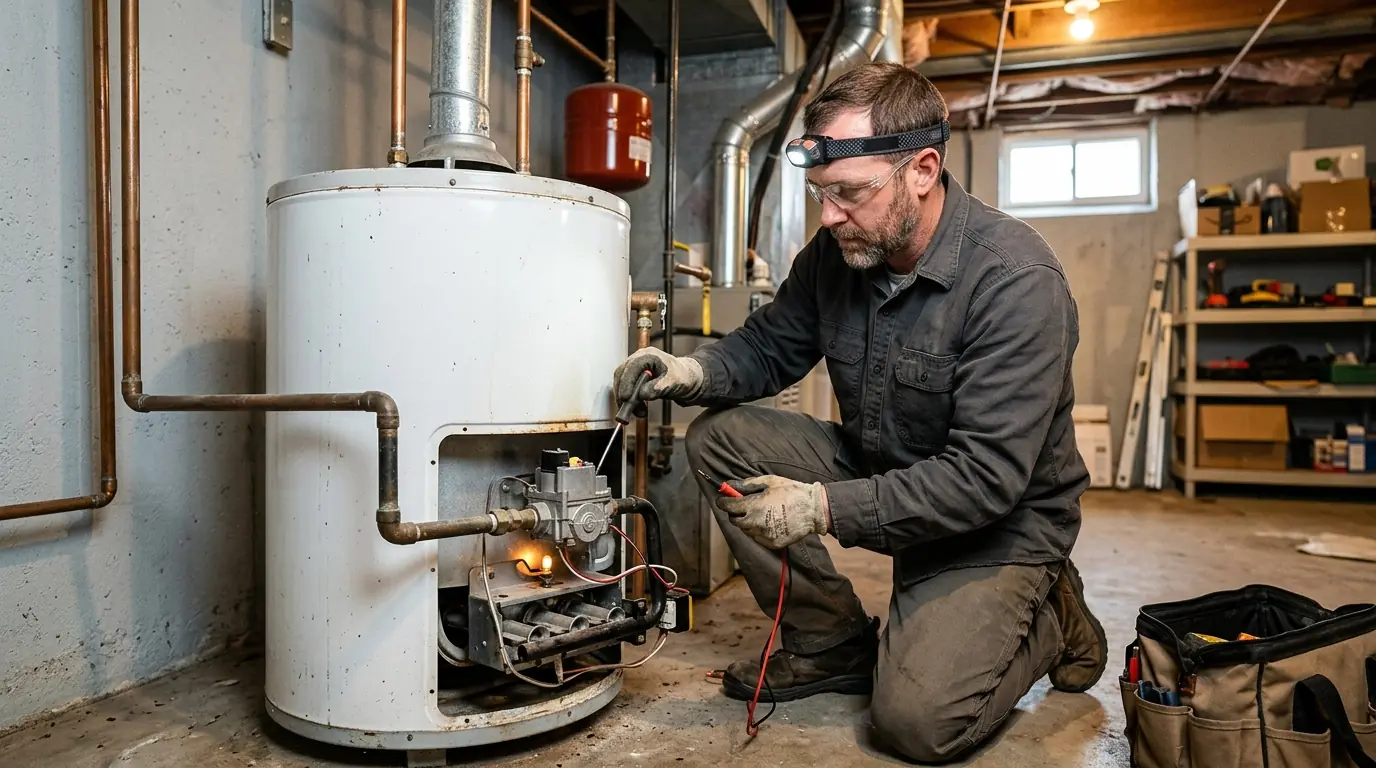
The detail that matters
What actually goes wrong, and why here
Expansion control is the detail that catches most Denver homeowners by surprise. When a pressure reducing valve or a backflow preventer sits on the incoming line, the plumbing becomes a closed system. Heated water expands with nowhere to go, pressure climbs, and the relief valve on the heater begins discharging. Homeowners then assume the new heater is faulty when the actual issue is a missing expansion tank.
Venting deserves the same attention. Many older Denver houses run a water heater and a furnace into a shared masonry chimney. When a high efficiency furnace gets installed and vented separately, the chimney is suddenly oversized for the water heater alone, the flue gases cool, and condensation begins damaging the liner. Replacing a heater in that house may require a liner rather than a straight swap.
Gas sizing rounds it out. Adding capacity at the heater without checking the supply line diameter can starve appliances during simultaneous demand. We calculate the load across the house rather than assuming the existing line is adequate because it worked before.
Planning the replacement instead of waiting for the flood?
Scheduled installs cost less than emergency ones and let you choose the unit rather than take what is available.
Call (720) 698-9746Brands We Service
- Rheem
- A.O. Smith
- Bradford White
- Navien
- Rinnai
- Weil-McLain
- Burnham
- Moen
- Kohler
- Zoeller
What you get
What changes after the visit
The unit is sized to your household
First hour rating is matched to actual fixture count and usage, not to whatever was there before.
Code issues get corrected during the swap
Expansion control, venting slope, and drain pans are brought current while the space is open.
The permit is pulled and inspected
Documentation matters at resale, and unpermitted work surfaces during inspection.
Old unit removal is included
The failed tank leaves with the crew rather than sitting in your garage.
Manufacturer warranty is registered
Coverage that requires registration gets registered rather than quietly lapsing.
Denver rules and local conditions that apply
Denver requires a permit for water heater replacement, and the inspection checks venting, expansion control, seismic strapping, and relief valve discharge routing. Unpermitted installs commonly surface during a resale inspection.
Altitude changes combustion. Appliances installed above five thousand feet often need derating or a different orifice, and a unit set up for sea level will not burn cleanly here.
What happens after you call
We look at how you use hot water
Fixture count, household size, and peak demand times drive the sizing rather than the old label.
You receive a written quote
Equipment, labor, code corrections, and permit fees itemized before anything is ordered.
The permit is pulled
Denver Community Planning and Development processing begins before the install date.
Old unit out, new unit in
Draining, removal, setting, connection, and expansion control all happen in one visit.
Combustion and draft are verified
The unit is tested under load and the inspection is coordinated before the file closes.
How long the work takes
A straight tank for tank replacement in an accessible basement usually runs three to five hours. Installs requiring a chimney liner, gas line upsizing, or relocation extend into a full day.
Permit processing runs alongside rather than blocking the work in most cases. Inspection is scheduled afterward, and we coordinate it rather than leaving you to chase it.
Warning signs
Signs the problem is already under way
The tank is past ten years
On Denver water that is deep into the failure window, and planned replacement beats an emergency one.
Rust colored water at hot taps
The anode is gone and the tank steel is now the sacrificial metal.
Recovery has become unworkable
When the second shower is always cold, sediment has taken the capacity you paid for.
Visible corrosion at the top fittings
Nipple corrosion often means the tank interior is in worse condition than the exterior suggests.
No expansion tank on a closed system
Denver homes with a check valve or pressure reducing valve need one, and many older installs lack it.
The flue has a backward slope
A vent that does not rise continuously can spill combustion gases into the room.
Water Heater Installation coverage by ZIP code
Why this crew
Why homeowners call us back
One point of accountability
The technician who diagnoses the problem stands behind the repair.
Built for Front Range conditions
Hard water, expansive clay, and a deep frost line shape every recommendation.
Priced before work starts
Written figures, no hourly surprises, and a straight answer on the cheaper path.
Old systems taken seriously
Prewar boilers, cast iron stacks, and clay laterals get repaired where repair is honest.
Common questions
Questions we field on this work
Three to five hours for a straightforward basement swap. Chimney lining or gas line work extends it toward a full day.
It depends on fixture count and peak demand rather than household size alone. A three bathroom house with back to back morning showers needs a higher first hour rating than the same square footage with staggered schedules.
Yes, Denver requires one for replacement. We pull it and coordinate the inspection.
Because a pressure reducing valve or backflow preventer has made your plumbing a closed system. Without expansion control the relief valve will discharge repeatedly.
Sometimes. It depends on gas supply, venting routes, and how your household draws hot water. That comparison is covered on the tankless page.
Primarily Rheem, A.O. Smith, and Bradford White, because their parts are stocked locally when service is needed later.
Yes, removal and disposal are included.
Only if the water is managed. Annual flushing and anode attention matter more than the warranty length printed on the label.
Yes, though pan and drain routing requirements are stricter and the labor runs higher.
Get the tank sized and quoted properly
We measure demand, price the code corrections honestly, and handle the permit.