Drain Cleaning in Denver, CO
Water standing in the sink long after the tap goes off? Drain cleaning in Denver clears the blockage and then answers the more useful question: whether the line will do it again next month or hold for years.
Quick answer
How often do Denver drains actually need cleaning?
Most Denver households need drain cleaning every eighteen to thirty six months, but homes on pre-1970s clay laterals with mature elm or cottonwood cover often need annual attention. The interval depends on the pipe material and what sits above it, not on household habits alone.
Updated August 2026 by Colton Brackett, Lead Plumber
What this work actually covers
Drain problems divide cleanly by how many fixtures are affected, and that division tells you most of what you need to know before anyone arrives. One slow fixture means a local blockage in that trap or branch line. Several fixtures backing up together means the problem has moved downstream toward the main.
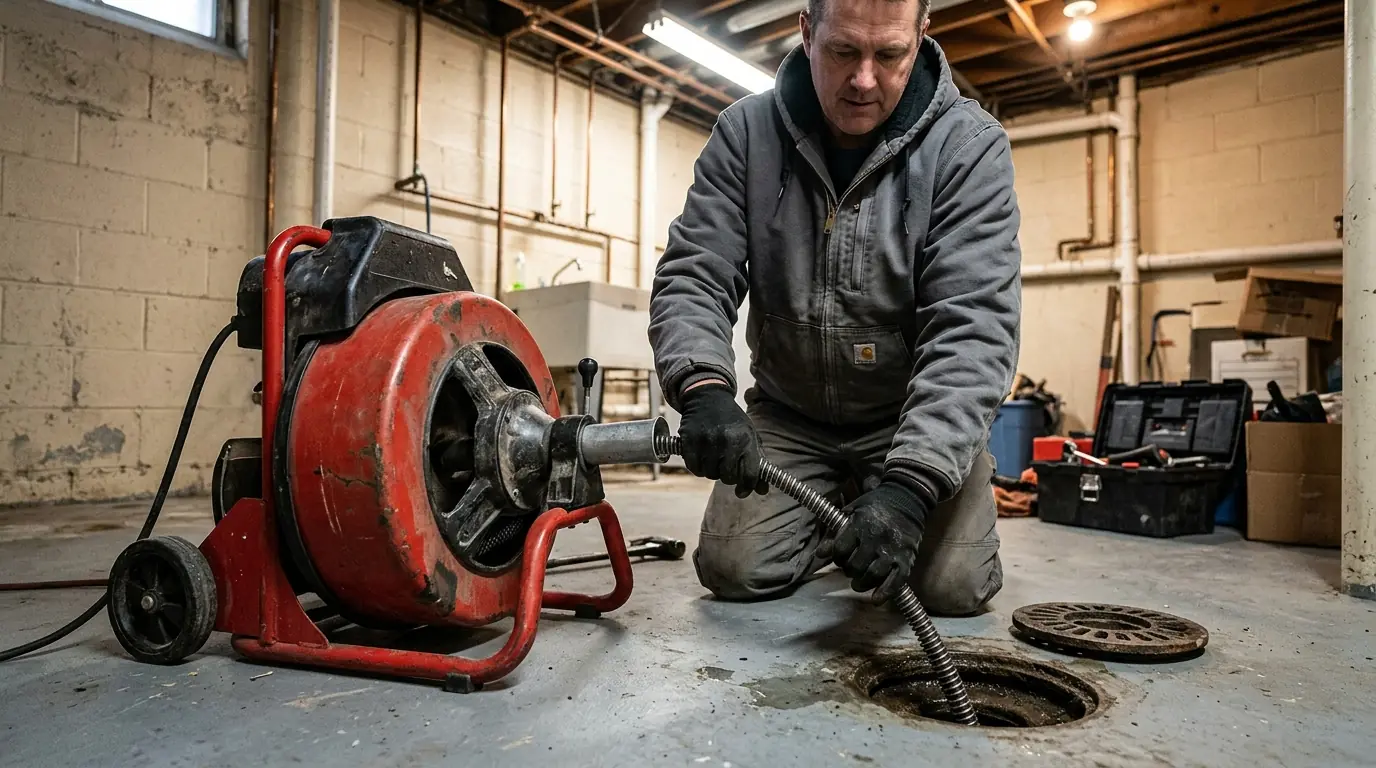
The distinction matters because the tools differ entirely. A kitchen branch responds to a small cable that clears grease and food debris within a few feet of the trap. A main lateral obstructed by root intrusion needs a larger machine, and afterward it needs a camera, because clearing roots without seeing where they entered is a temporary result presented as a permanent one.
Denver adds its own pattern. Neighborhoods platted before the seventies frequently still run clay lateral pipe with mortared joints, and the tree canopy that makes Park Hill and Wash Park pleasant is the same canopy sending roots into those joints.
The detail that matters
What actually goes wrong, and why here
Grease is the most misunderstood cause in Denver kitchens. It leaves the sink as a warm liquid, travels a few feet, cools against pipe that sits in an unheated crawl space, and solidifies on the wall of the line. Each subsequent wash adds a layer. By the time the sink slows, the interior diameter may be reduced by half.
Roots work differently and are far more consequential. A hairline gap at a clay joint releases moisture into surrounding soil, and a mature elm finds it. The root mass then expands each season and traps everything the household flushes. Cutting it restores flow, but the entry point remains.
That is why the camera matters more than the cable. Clearing tells you the line moves again. The camera tells you whether you are looking at annual maintenance, a spot repair, or a full lateral replacement, and those three answers differ by an order of magnitude in cost.
What you get
What changes after the visit
The line is cleared, not just poked through
Cutting the full diameter beats punching a hole that closes again within weeks.
You see the cause on camera
Root intrusion, grease, a belly, or a broken section each carry different consequences.
Recurrence gets predicted honestly
When a line will block again, we say when and why rather than selling annual surprise.
No caustic chemicals
Drain acids damage older cast iron and clay and rarely reach a real blockage anyway.
Cleanout access gets documented
Knowing where your cleanout is makes every future visit faster and cheaper.
What a drain cleaning visit includes
- Identifying whether the blockage is local or in the main
- Locating and opening the correct cleanout access
- Cable or auger sized to the pipe diameter
- Cutting the blockage to full line diameter rather than boring through
- Camera inspection of the cleared line where the main is involved
- Identifying the cause on screen so you see it too
- A written verdict on whether recurrence should be expected
- Cleanout location documented for future visits
Warning signs
Signs the problem is already under way
Gurgling from a nearby drain when another runs
Air being displaced through a partially blocked shared line.
Several fixtures slowing at once
The obstruction has moved past the branch lines toward the main lateral.
Sewage odor near a floor drain
A dry trap or a blockage holding waste in the line rather than moving it.
Water rising in the tub when the toilet flushes
A classic indication the main is restricted rather than a single fixture.
Repeat clearing every few months
Recurrence points at a structural cause such as roots or a belly, not at habits.
Slow drainage after heavy rain
Groundwater entering through cracked joints can overwhelm a line that otherwise copes.
Second drain in the house running slow?
When more than one fixture slows together the problem has moved toward the main line, and waiting makes the cleanup worse.
Call (720) 698-9746Brands We Service
- Rheem
- A.O. Smith
- Bradford White
- Navien
- Rinnai
- Weil-McLain
- Burnham
- Moen
- Kohler
- Zoeller
How long the work takes
A branch line clearing typically takes under an hour. A main lateral obstructed by roots usually runs one to three hours depending on distance from the cleanout and the density of the mass.
Camera inspection adds roughly twenty to forty minutes and is worth it on any main line, because the recording is what makes the repair decision an informed one.
What happens after you call
You describe which fixtures are affected
One slow drain and three backing up point at different parts of the system.
The right access point is opened
Working from the correct cleanout protects finishes and reaches the blockage directly.
The line is cut to full diameter
Machine and cutter head are matched to the pipe rather than to whatever is on the truck.
A camera confirms the result
On main lines the camera shows both that it is clear and what caused it.
You get the honest forecast
Whether this recurs, roughly when, and what would stop it permanently.
Denver rules and local conditions that apply
The homeowner owns the sewer lateral from the house to the city main in Denver, including the portion under the street. That ownership boundary is why lateral repairs land on the property owner rather than on the utility.
Neighborhoods platted before the seventies commonly carry clay lateral pipe with mortared joints, and mature street trees in Park Hill, Berkeley, and Washington Park sit directly over many of those runs.
Handling it yourself against calling us
| Factor | Doing it yourself | Calling us |
|---|---|---|
| Slow single sink | A store bought chemical that may damage older pipe | A cable sized to the branch that removes the blockage |
| Main line backup | A rented auger with no way to see the result | Machine matched to the line, then camera verification |
| Root intrusion | Cutting blind and hoping | Camera locates the entry point and the repair options get priced |
| Grease buildup | Boiling water that moves it further along | Cutting to full diameter, or jetting where buildup is heavy |
| Recurring blockages | Clearing again every few months | Finding the structural cause so the cycle can actually end |
Budgeting
What moves the price up or down
Where the blockage sits
A branch line near the trap costs considerably less than a main lateral clearing.
Cleanout access
No accessible cleanout means pulling a toilet or accessing from the roof, which adds labor.
Cause of the blockage
Grease clears faster than a dense root mass in a clay joint.
Camera inspection
Included on main line work, priced separately when requested on a branch.
Time of day
After hours dispatch carries a higher rate than a scheduled visit.
Why this crew
Why homeowners call us back
One point of accountability
The technician who diagnoses the problem stands behind the repair.
Built for Front Range conditions
Hard water, expansive clay, and a deep frost line shape every recommendation.
Priced before work starts
Written figures, no hourly surprises, and a straight answer on the cheaper path.
Old systems taken seriously
Prewar boilers, cast iron stacks, and clay laterals get repaired where repair is honest.
Common questions
Questions we field on this work
Every eighteen to thirty six months for most Denver homes. Properties on clay laterals under mature trees frequently need annual attention.
They damage older cast iron and clay, rarely reach a real blockage, and create a hazard for whoever opens the line afterward. We do not recommend them.
Because the first clearing bored a hole through the blockage rather than cutting to full diameter, or because a structural cause such as roots remains.
Not for a single slow sink. On any main line backup it is worth doing, because it distinguishes maintenance from a repair you should be budgeting for.
No. Cutting restores flow but the entry point stays. Permanent solutions are lining or replacing the affected section.
It is a capped access fitting into the drain line, usually outside near the foundation or in the basement. Many older Denver homes have one that has been buried by landscaping.
For heavy grease and scale, yes. Hydro jetting scours the pipe wall where a cable only cuts a channel.
Treat it as one. It indicates the main is restricted, and every fixture used adds to what surfaces.
Yes, and those generally need a scheduled interval rather than reactive visits.
Get the line cleared and the cause identified
Clearing is the easy part. Knowing whether it returns is what the visit is actually worth.