Repipe or Repair Galvanized Pipe in Denver
One pinhole is an event. Two within eighteen months is a pattern. The difference matters because patching a pattern is how households spend replacement money in instalments without ever getting a replacement.
Quick answer
When should galvanized pipe be replaced rather than repaired?
Galvanized supply should be replaced when repeat pinholes, discolored hot water, and pressure that collapses under simultaneous demand appear together. Any two of those on original pipe past sixty years is the practical threshold, because corrosion is systemwide rather than local to the point that failed.
By Colton Brackett, Lead Plumber · Reviewed by Shane Pettigrew, Service Manager · Updated August 2026
How galvanized actually fails
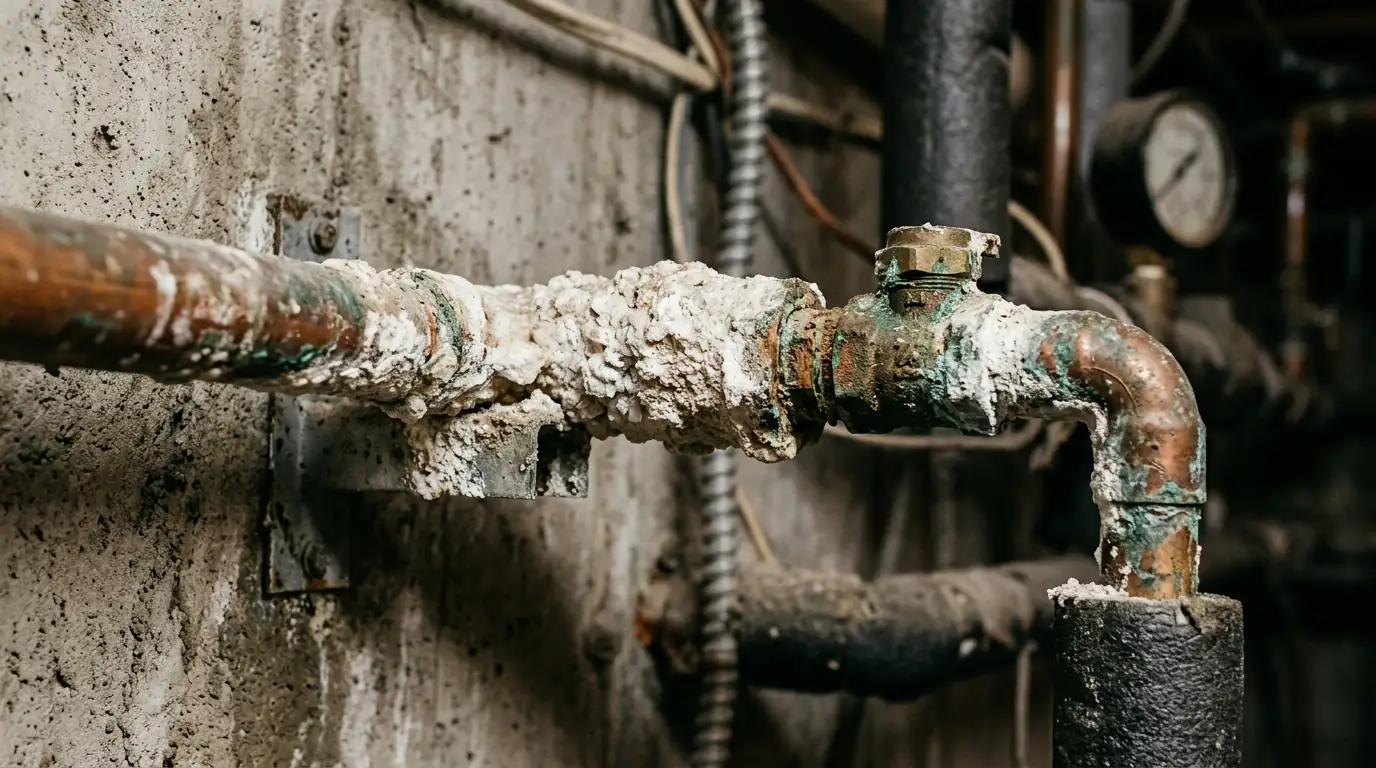
Galvanized steel is zinc coated pipe, and the zinc is what protects the steel underneath. Once that coating is consumed, water is in contact with bare steel and rust begins forming on the inside wall rather than the outside.
The rust builds inward. It narrows the bore, restricts flow, and sheds particles into the water, which is where brown or metallic tasting hot water comes from. The wall thins from the inside at the same time.
The failure point is wherever the wall reaches its limit first, and that is usually at threaded joints because threading removes material. It looks local. It is not.
Reading the three symptoms together
Discolored water at hot taps that clears after a minute of running is corrosion product settling in the pipe between uses. It is the earliest of the three and the easiest to dismiss.
Pressure that collapses when two fixtures run simultaneously is the narrowed bore refusing to carry combined demand. Households usually adapt to this rather than reporting it, staggering showers without consciously deciding to.
Repeat pinholes are the third, and by the time they appear the other two are almost always present. Any two together on pipe past sixty years is where the arithmetic changes.
Where a spot repair is still the right call
A single failure on galvanized that is otherwise carrying good pressure and clean water is worth repairing. Not every old system is at the end, and condemning one that has years left is its own kind of dishonesty.
The useful thing is to look at the cut pipe. A technician removing a failed section can show you the wall thickness and the internal buildup at the break, and that is direct evidence about the rest of the run rather than an opinion about it.
If the bore is visibly closing and the wall is thin, that same condition exists everywhere else of the same age. If it looks reasonable, a repair is a repair.
What repiping actually replaces
Repiping means the supply distribution inside the building, from the main shutoff out to every fixture. It does not include the drains, which have separate triggers, and it does not include the buried service line from the meter.
That last distinction catches people out. A house can have new interior pipe and still suffer whole house pressure loss, because the restriction is in the service line outside rather than the distribution inside.
Establishing which one is responsible takes a pressure comparison at the meter and at the house, and it should happen before either project is priced.
PEX or copper in a Denver house
PEX is flexible, routes through existing wall cavities with far fewer openings, tolerates freezing better than rigid pipe, and costs less in labor. On a finished house with plaster walls, access is most of the expense, and PEX usually wins on total cost for that reason alone.
Copper is rigid, needs more openings to install, handles high temperature well, and some owners simply prefer it. Where a basement is unfinished and routing is straightforward, the gap narrows considerably.
Neither is a wrong answer. The decision should be explained rather than assumed, and a contractor who only offers one has made the choice for you.
Second pinhole leak this year?
Two failures in a short window is information rather than bad luck. A walk through puts a real number against the alternative.
Call (720) 698-9746Living in the house while it happens
A typical two bathroom Denver house repipes in three to five working days. Slab construction and finished basements extend that, occasionally toward two weeks.
Staging is what makes it survivable. Working section by section, keeping the kitchen live until its turn, means water service is retained through most of the project with short planned shutoffs during tie ins.
It costs slightly more in labor than gutting the whole system in one pass, and for an occupied house it is almost always the right trade.
Why pressure drops before anything leaks
Corrosion narrows the bore from the inside long before it thins the wall enough to perforate. A three quarter inch line carrying a quarter inch of internal rust is delivering a fraction of what it was sized for.
Households adapt to this without noticing. Showers get staggered, the dishwasher runs at night, and nobody consciously decides any of it.
It is worth measuring rather than guessing. Comparing pressure at the meter against pressure at a fixture separates a restricted service line from restricted interior distribution, and those are two different projects.
What happens to the shutoff valves
Multi turn stops under sinks and behind toilets seize in whatever position they have occupied for decades. Attempting to close one during a repair frequently means it will not seal again afterward.
That turns a small planned job into an unplanned larger one at the worst moment. Replacing them with quarter turn stops during any repipe costs very little while the walls are open.
It is also worth testing the main shutoff on any older house. Discovering it is seized during a burst pipe is the most expensive possible time to find out.
What the water quality change looks like
Households frequently describe the improvement after a repipe in terms nobody expects: laundry coming out cleaner, kettles scaling less obviously, and shower pressure that no longer collapses when someone runs a tap downstairs.
That is not the softener effect, which is a separate system entirely. It is simply what happens when water stops travelling through several decades of accumulated rust before reaching a fixture.
It is worth setting expectations honestly though. Repiping does not change hardness, so scale on fixtures continues exactly as before unless that is addressed separately.
What it does and does not fix
Repiping restores flow and pressure genuinely, because new full bore pipe carries what corrosion had been taking gradually. Discoloration stops at the source rather than being filtered out downstream.
It does not soften the water. Hardness is dissolved mineral and needs ion exchange, which is a separate system covered on the softener page.
It also does not address drains, vents, or the sewer lateral. Those are different systems with different lifespans, and bundling them into one conversation usually serves the person selling rather than the person buying.
Common questions
Questions about galvanized pipe
There is no fixed age. Past sixty years the failure window is open, but condition at the cut is better evidence than the calendar.
It treats the symptom while the source keeps producing it. Clean water comes from clean pipe.
No. That is the service line and it is quoted separately, though the two are sometimes done together.
Openings are needed at strategic points rather than throughout. Patching is included; texture and paint are usually separate.
Documented repiping removes a known objection, and failing galvanized is a common negotiation point against sellers.
Get an honest read on what your pipe has left
A walk through, the evidence at the cut, and both paths priced against each other.