Signs Your Denver Sewer Line Is Failing
Sewer laterals rarely fail silently. They send signals for months first, and the reason people miss them is that each one looks like a separate small nuisance rather than a single buried pipe running out of time.
Quick answer
What are the warning signs of a failing sewer line?
A failing Denver sewer lateral usually shows repeat backups at short intervals, gurgling from drains when other fixtures run, patches of unusually green grass over the run, sewage odor outdoors, and sometimes rodent activity indoors. Any two of those together warrant a camera inspection rather than another clearing.
By Colton Brackett, Lead Plumber · Reviewed by Shane Pettigrew, Service Manager · Updated August 2026
Backups that return on a schedule
One backup is an event. A second within a few months is a pattern, and patterns have structural causes rather than behavioural ones. Households usually respond by changing what goes down the drain, which is reasonable and almost never the actual issue.
The interval itself carries information. A line clearing every twelve to eighteen months is usually accumulating root hair through a joint that reopens each growing season. A line blocking every few weeks has something more definite in it, whether a root mass, a collapse, or a sag holding solids.
The useful question after a clearing is not whether the drain runs. It is why it stopped, and that answer only exists on camera.
Gurgling, and what the air is telling you
A drain that gurgles when a different fixture runs is describing a restriction downstream of both. Water moving through a partly blocked line displaces air, and that air escapes through the nearest available trap.
It is worth paying attention to which fixtures are involved. Gurgling confined to one bathroom points at a branch line. Gurgling in the basement when an upstairs toilet flushes points at the main lateral, which is a different problem and a different bill.
The same logic applies to a tub filling when a toilet flushes. That is not a coincidence between two fixtures; it is the main line telling you it cannot take both at once.
Signs that show up outside the house
A strip of grass noticeably greener than the rest of the lawn, running in a line, is effluent escaping a cracked joint and fertilising the soil above it. It is one of the more reliable outdoor indicators and it is easy to mistake for uneven watering.
A depression forming along the same line means soil has been migrating into the pipe. That void settles at the surface, and it indicates the pipe is no longer holding the ground around it rather than merely leaking.
Sewage odor outdoors near the run is gas escaping through a break rather than venting through the roof as designed. Indoors, the same smell usually means a dry trap, which is a much smaller problem.
Rodents indoors, and why they are a plumbing symptom
Rats travel sewer laterals routinely, and a break in the pipe gives them a route into the building envelope. Rodent activity appearing in a basement with no obvious exterior entry point is worth treating as a plumbing question rather than only a pest one.
It is not a subtle indicator when it happens, and it usually means a defect large enough to be visible on camera immediately.
Pest control addresses the animals. It does not address the opening they came through, and the two need handling together rather than in sequence.
Backing up again after the last clearing held a month?
Short intervals mean a defect rather than habits. A camera run puts a location and a price on it before the next backup.
Call (720) 698-9746Why Denver produces so much of this
Neighborhoods platted before the 1970s across Park Hill, Berkeley, Capitol Hill, and Washington Park largely carry clay lateral pipe with mortared joints. Clay itself is durable and frequently sound after a century. The joints between sections are not.
Expansive bentonite clay soil underlies much of the metro, swelling when wet and shrinking when dry. That movement opens joints a few millimetres, which is all a root needs.
The mature elm and cottonwood canopy that makes those neighborhoods pleasant is standing directly over the laterals. Roots follow released moisture into the gap, and once inside the mass expands every season.
What a camera run settles, and what clearing does not
Clearing restores flow, which is genuinely useful and sometimes urgent. It tells you nothing about why the line stopped, and on clay laterals it is a reprieve rather than a repair.
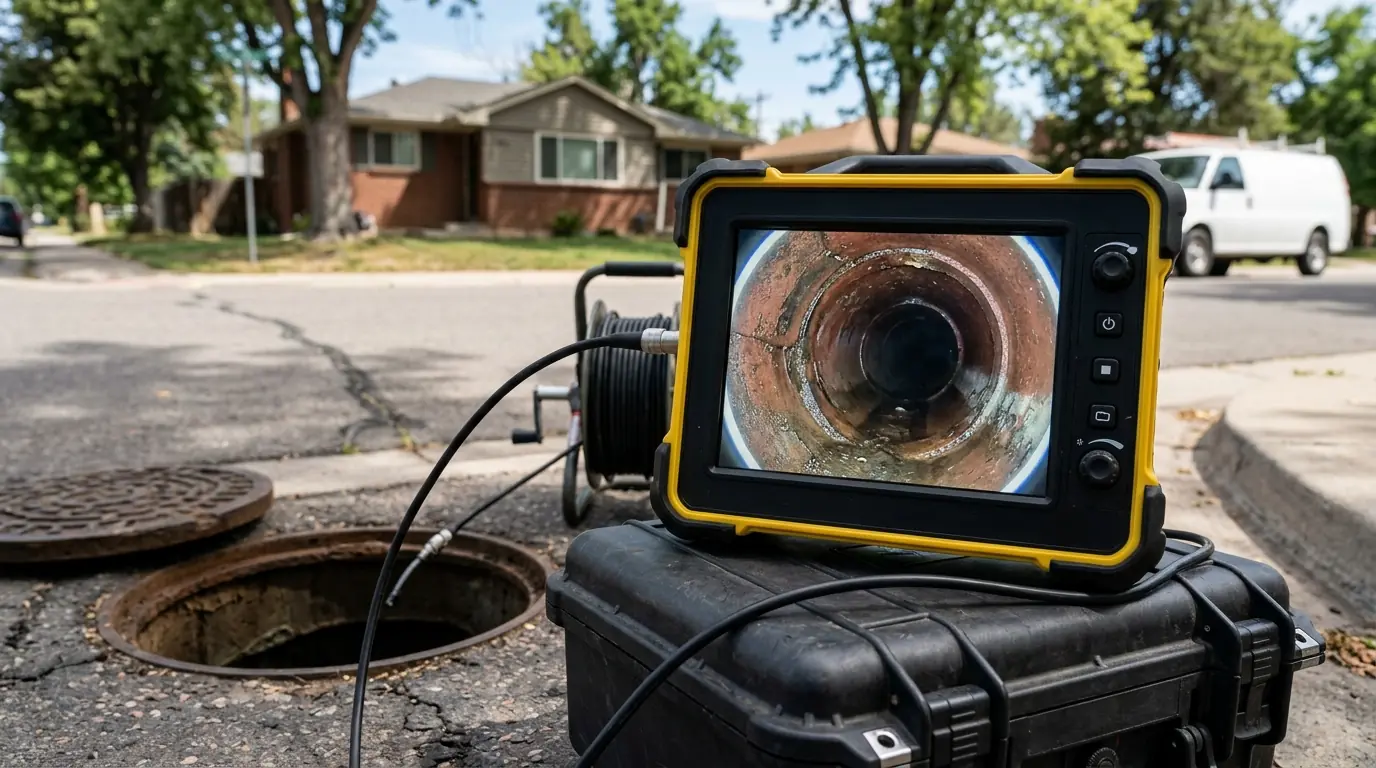
A camera with a locator identifies the pipe material instantly, records every defect against its distance from the access point, and puts a depth reading on the surface where excavation would happen. That is what separates a spot repair from a full replacement, and the two differ by roughly an order of magnitude.
Anyone quoting excavation without having run a camera is estimating rather than quoting. The inspection page covers what a run involves, and the repair page covers what follows from it.
What clearing costs against what it postpones
Clearing a main lateral runs one to three hours depending on distance from the cleanout and how dense the obstruction is. On a line with a genuine defect that becomes an annual expense rather than a one off.
Three or four years of annual clearing frequently approaches the cost of a located spot repair that would have ended it. That arithmetic is worth doing rather than absorbing the clearing as a fact of life.
The camera is what makes the comparison possible. Without it there is no way to know whether the recurrence is a joint you could repair for a modest figure or a line failing along its length.
Who owns which part of the pipe
In Denver the property owner is responsible for the sewer lateral from the building all the way to the city main, including the section beneath the street and the sidewalk.
That surprises most homeowners the first time it matters, and it is why a root problem in the parkway strip is a homeowner expense rather than a utility one.
Work extending into the public right of way carries approval beyond the standard plumbing permit, which belongs in a quote rather than appearing as an extra partway through.
When it is worth acting before anything fails
Buying a Denver property built before 1975 is the clearest case. Standard residential purchase inspections in Colorado do not include the sewer lateral, and that omission is the single most expensive gap in the report.
A documented defect found before closing is a number a seller can be asked to address. The same defect found in March is entirely yours.
For an owner with no symptoms and no purchase pending, it is optional. On an older property under mature trees it remains cheap relative to what it rules out.
Common questions
Questions about sewer line failure
The pipe frequently outlives the house. The mortared joints between sections are what fail, and soil movement plus root pressure is what opens them.
Root treatments slow regrowth temporarily. They do not close the entry point, so the intrusion returns.
No. A single slow fixture is almost always a local branch issue, which is the cheapest category of drain work.
Usually not for the pipe itself. Service line endorsements exist and are worth checking before you need one.
On any Denver property built before 1975, yes. Lateral repair is a five figure risk a standard inspection does not cover.
Find out what the line is actually doing
One camera run separates maintenance from a repair you should be budgeting for.