What a Sewer Camera Inspection Actually Shows
The footage is not really the product. The decision it makes possible is: whether you are looking at annual maintenance, a spot repair on two joints, lining, or a full replacement. Those four differ by an order of magnitude.
Quick answer
What does a sewer camera inspection show?
A sewer camera inspection identifies the pipe material, records every defect against its distance from the access point, and puts a depth reading on the surface using a transmitter in the camera head. Together those establish whether a line needs clearing, a spot repair, lining, or replacement.
By Colton Brackett, Lead Plumber · Reviewed by Shane Pettigrew, Service Manager · Updated August 2026
How the equipment works
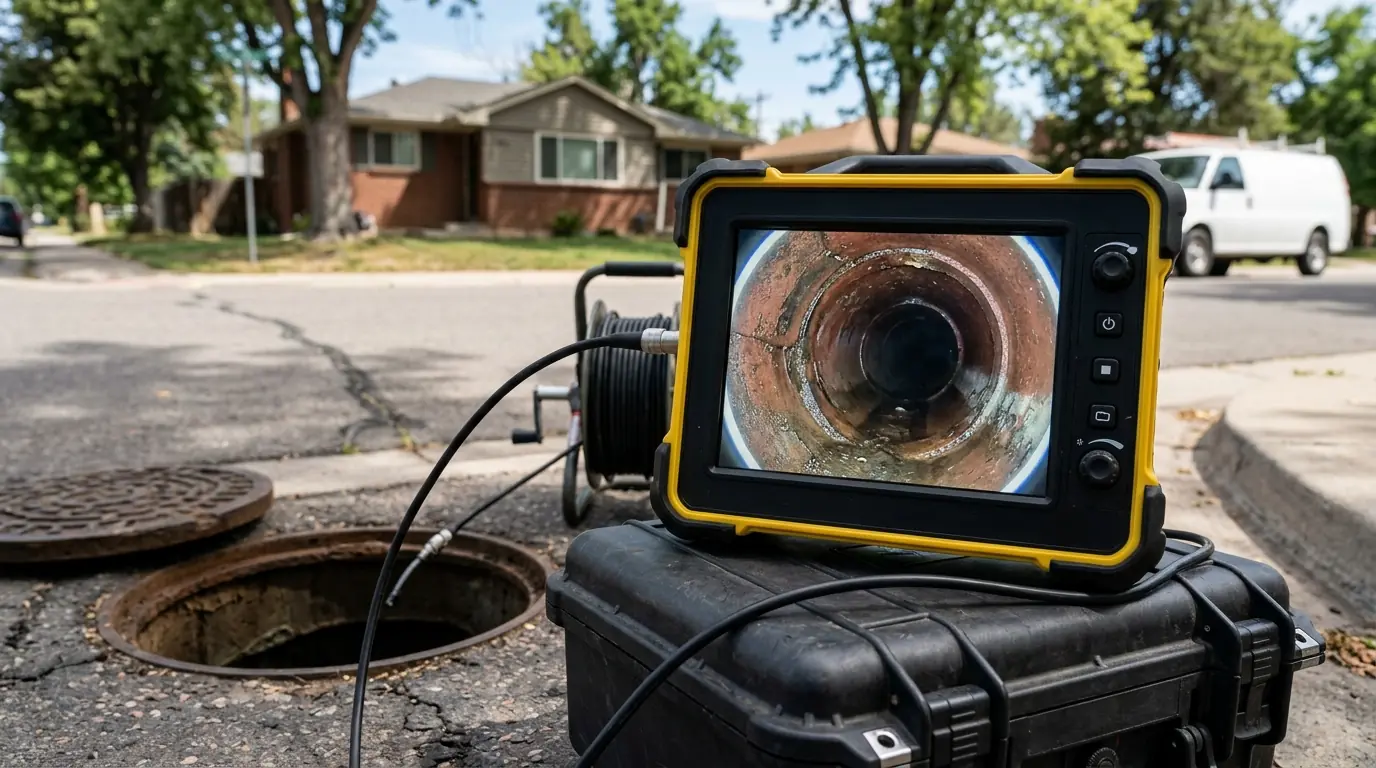
A self levelling camera head on a flexible rod feeds from a cleanout toward the city main while the operator watches the feed. Self levelling matters because it keeps the picture upright as the head rotates, which is what makes the footage readable later.
A sonde in the head transmits a signal that a locator picks up from the surface. That gives a position on the ground and a depth reading, which is what turns a defect on a screen into a mark where excavation would happen.
Footage is recorded with a distance counter running, so each finding is tied to how far it sits from the access point rather than described vaguely.
Reading the pipe material first
Material is the first thing identified because it predicts everything after it. Clay appears as segmented sections with visible joints every two to five feet, and those joints are where failure concentrates.
Cast iron looks continuous with a rougher interior, often tuberculated with corrosion nodules. It is durable but corrodes at hubs and at the base of stacks.
Orangeburg is dark and fibrous and frequently shows an oval bore rather than a round one. It was manufactured from wood pulp and pitch, installed widely in the postwar decades, and it cannot be patched or lined. Identifying it on camera settles the question immediately.
Sorting defects by consequence
Root hair passing through a joint is maintenance. It clears, it comes back on a seasonal cycle, and it is a scheduling question rather than a repair one.
A root mass filling the bore is a repair, because the entry point is now large enough to matter and cutting it only resets the clock.
An offset joint, where one section has dropped below the next, is structural. Soil visible inside the pipe is worse again, because ground is migrating in and the surface above will eventually settle.
Standing water, and why it is misread
A stretch of standing water in an otherwise sound line usually indicates a belly, where bedding settled and the pipe lost its fall. It is the finding people most often misinterpret.
A belly does not leak, so it never triggers the alarm a crack does. It collects solids indefinitely, which is why some lines block every year despite thorough clearing and despite showing no obvious damage.
It also matters for method selection. Lining seals leaks but follows existing grade, so a liner does not correct a belly. That distinction has to be explained before the work rather than discovered afterward.
What the depth reading is for
Depth drives excavation cost more than length does. Denver laterals commonly sit six to twelve feet down, and the deeper trench needs shoring, more spoil handling, and more restoration.
A located depth turns a vague quote into a specific one. It also tells you whether trenchless methods are worth pricing, because the savings scale with how much excavation is avoided.
Two houses on the same block receiving very different quotes usually differ on depth rather than on anything the contractor is doing.
Been quoted for excavation without seeing footage?
No honest quote on buried pipe exists before someone has looked inside it. A camera run takes under ninety minutes.
Call (720) 698-9746When an inspection is worth doing
Before buying a Denver property built before 1975 is the clearest case. Standard residential purchase inspections in Colorado exclude the sewer lateral, and repair is a five figure risk.
After a second backup within a short window, because the interval is telling you there is a defect and clearing again does not identify it.
Before agreeing to any excavation quote. A contractor pricing a dig without footage is estimating, and the recording is what lets you compare two quotes on the same problem.
Access, and why the cleanout matters
The camera enters through a cleanout, which is a capped access fitting into the drain line, usually outside near the foundation or in the basement. Many older Denver properties have one that landscaping has buried over the years.
Where no usable cleanout exists, access means pulling a toilet or working from the roof vent, both of which add time and cost before the inspection even begins.
Having the location documented is worth more than it sounds. Every future visit, whether clearing or inspecting, starts faster and cheaper when nobody has to find it first.
What the footage cannot tell you
A camera shows the inside of the pipe. It does not show wall thickness, so a cast iron line can look acceptable while having lost significant material behind the surface.
It also cannot see past a full blockage or through standing water in a deep belly, which is why some inspections end with a recommendation to clear and return rather than a verdict.
Being told the limits honestly is part of a competent inspection. A report that projects certainty about everything is describing confidence rather than evidence.
Reading a report you did not watch being made
If you were not present, the recording plus a written summary should still let you follow what happened. A distance counter running on screen and a spoken or written note at each finding is what makes that possible.
Be wary of a report consisting of a single still image and a conclusion. One frame proves very little about a run that may be eighty feet long.
The useful test is whether the report distinguishes what was observed from what was inferred. Roots at forty two feet is an observation. This line needs replacing is a conclusion, and the two should be separable.
What you should get afterward
The recording itself, which is yours. It matters if you are negotiating a purchase or comparing repair quotes, and it is the baseline that makes any later change measurable.
A written summary of the findings and the options they imply, rather than a verbal account that becomes hazy in a week.
The marked position on the surface where any excavation would occur. The inspection page sets out what a run covers, and the trenchless page covers when lining becomes viable.
Common questions
Questions about camera inspections
Usually under ninety minutes for a residential run, plus additional time where locating and surface marking are needed.
No. The line has to be cleared first, and that is quoted separately before it starts.
No. The head is small and flexible and applies far less force than a cable does.
Yes. It is yours, and it matters when comparing quotes or negotiating a purchase.
On an older property under mature trees it is cheap insurance. With no symptoms and no purchase pending it is optional.
Put the line on record before you spend
Footage, a marked location, a depth reading, and a written summary you can act on.