Why Denver Water Heaters Fail Early
A water heater rated for twelve years commonly gives out around year eight in Denver. That is not a manufacturing problem or bad luck. It is what Front Range water does to a steel tank that nobody flushes.
Quick answer
Why do water heaters fail early in Denver?
Denver water heaters fail early because Front Range supply carries dissolved calcium and magnesium that drop out during every heating cycle and settle as scale at the base of the tank. That layer insulates the burner from the water above it, forcing longer burns and cooking the steel from below.
By Colton Brackett, Lead Plumber · Reviewed by Shane Pettigrew, Service Manager · Updated August 2026
What the mineral actually does
Water reaching Denver taps has travelled through mountain rock and carries dissolved calcium and magnesium as a result. Neither is a health concern. Both come out of solution when the water is heated, and they settle where gravity puts them, which on a gas tank is directly above the burner.
That layer hardens into scale, and scale is an insulator. The burner now has to heat through it before reaching the water, so every cycle runs longer than designed. The steel between the flame and the scale gets hotter than it was ever meant to, and it degrades faster as a result.
The symptom people notice first is not the tank. It is that hot water runs out sooner than it used to, because the scale occupies volume that used to hold water.
The anode rod almost nobody knows about
Every steel tank contains a sacrificial rod, usually magnesium or aluminium, suspended inside it. Corrosion attacks that rod instead of the tank wall, which is the entire reason a steel vessel full of hot water lasts a decade rather than two years.
On Denver water an anode can be consumed in three or four years. Once it is gone, the tank itself becomes the sacrificial metal, and the countdown to a leak begins. Replacing the rod costs a fraction of replacing the heater.
Access is the practical obstacle. Tight utility closets frequently lack the headroom to withdraw a full length rod, which is where a segmented rod earns its cost. That single detail decides whether a tank reaches year fifteen or year eight.
Annual flushing, and when not to do it
Draining several gallons through the tank drain valve once a year pulls loose sediment out before it hardens. On a tank that has been flushed regularly it takes fifteen minutes and materially extends service life.
On a tank that has never been flushed, the layer may already be cemented, and aggressive flushing can dislodge material into the drain valve and jam it open. That is a genuine risk worth checking the age and condition before opening the valve rather than after.
Tankless units are not exempt. A Navien or Rinnai heat exchanger passes water through narrow passages at high temperature, which is exactly the condition that scales fastest, and descaling every twelve to eighteen months is mandatory on this water rather than advisory.
What a repair visit actually checks
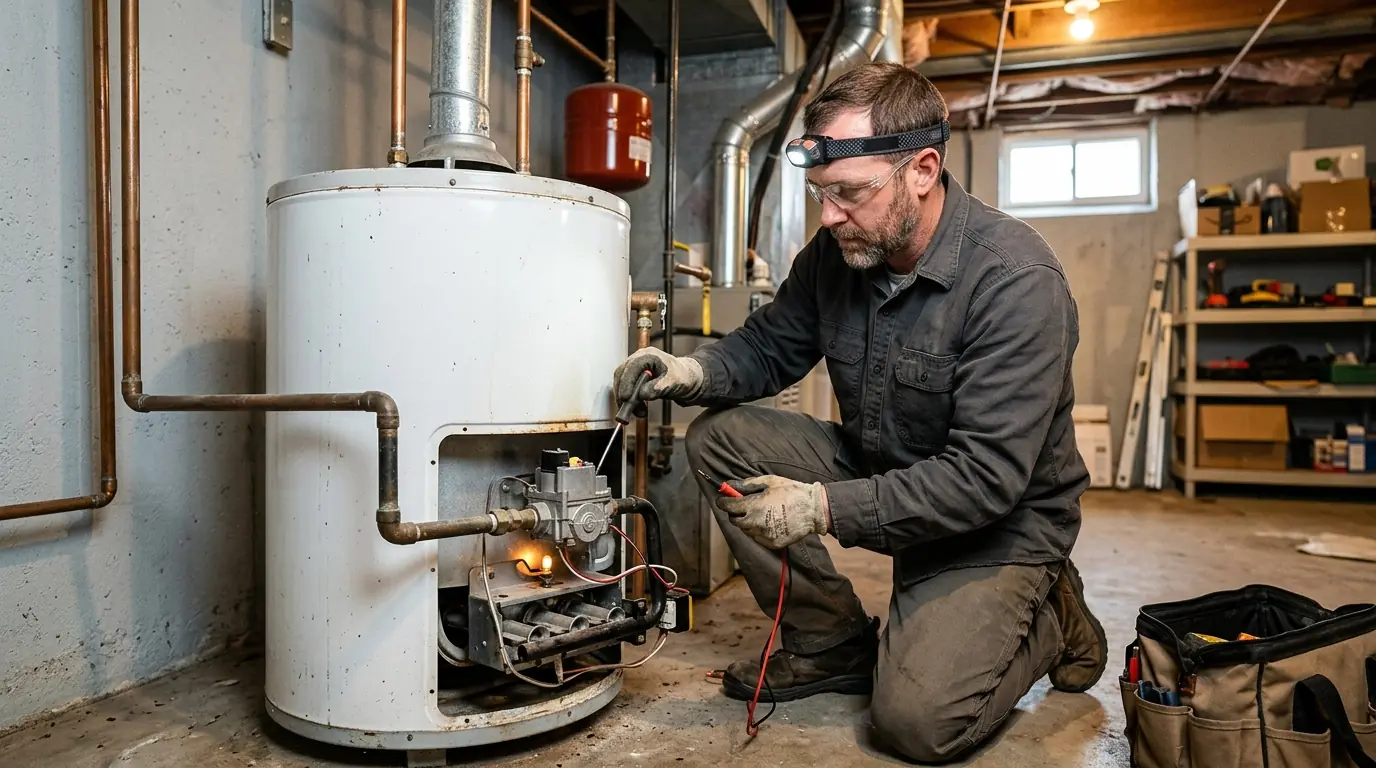
A proper diagnosis tests rather than guesses. Thermostat, thermocouple, igniter, and gas control valve each get checked against readings, because the symptom of no hot water covers several completely different failures.
Tank condition is assessed alongside the component. Age, anode state where access allows, and sediment level together determine whether repair is a sound investment or money spent on a unit already past saving.
Venting and draft get verified on atmospheric units as a matter of course. Backdrafting is a safety issue rather than an efficiency one, and it is the sort of thing that goes unnoticed for years in an older Denver basement.
Showers running cold three mornings running?
Most no hot water calls are a component costing a fraction of a new tank. Finding out which one comes before replacing anything.
Call (720) 698-9746Reading the warning signs in order
Failures announce themselves in a predictable sequence here. Recovery time stretches first, so the second shower runs cool. Then rumbling or popping starts during heating, which is water flashing to steam underneath the scale layer.
Rusty or metallic tasting hot water follows, and that one means the anode is spent and the tank steel is now exposed. Moisture around the tank base is the last stage, and by then repair is no longer on the table.
Catching it at the first two stages keeps the unit alive for years. Most no hot water calls turn out to be a thermocouple, an igniter, a thermostat, or a gas control valve, all of which are covered on the repair page.
Sizing the replacement when repair is not the answer
Once a tank is genuinely finished, the temptation is to buy the same size that came out. That is a reasonable default and frequently the wrong one, because the number that matters is first hour rating rather than raw capacity.
First hour rating combines tank volume with burner input, and it describes what the unit can actually deliver during peak demand. A household with three bathrooms running back to back morning showers needs a different figure from the same square footage with staggered schedules, even though the tank size on the label might match.
Oversizing carries its own cost. A larger tank spends all year keeping more water hot than the household uses, and that standby loss shows on a fuel bill every month rather than once. Matching the rating to real demand is the whole exercise.
What altitude changes about a gas appliance
Combustion appliances are rated at sea level, and air at five thousand feet carries meaningfully less oxygen. A unit installed here without adjustment burns rich, which wastes fuel and produces soot rather than clean combustion.
Most manufacturers publish derating guidance or supply a different orifice for high altitude installation. Applying it is not optional and it is not something a homeowner can verify by looking at the flame from across the basement.
It matters for venting too. Where a water heater shares a masonry chimney with a furnace, replacing either appliance changes the flue calculation for both. A high efficiency furnace vented separately can leave the chimney oversized for the heater alone, which cools the flue gases and starts condensation damaging the liner.
Whether a softener is worth it
A softener exchanges hardness minerals on a resin bed before the water reaches anything. It does not filter and it does not improve drinking quality; it protects equipment, and that is where the return sits.
The honest calculation is whether the equipment being protected justifies the unit cost plus ongoing salt. A household replacing its second heater in a decade usually finds that it does. A household with a new tank and no other affected appliances is a closer call.
Where hardness is highest, generally north metro toward Brighton and Commerce City, the case is strongest. Testing your actual supply rather than assuming a citywide average is the sensible first step, and it is covered on the softener page.
Common questions
Questions about water heater life in Denver
Once a year on this water. Homes without a softener may benefit from more frequent attention, particularly in the north metro.
Sometimes. If the tank is sound and the failure is a control component, repair adds years. If the anode is long gone and the seam is weeping, it is not.
Water trapped under a hardened scale layer flashing to steam. It signals a flush is overdue and, on older tanks, that the scale is already cemented.
No, it changes it. Tankless heat exchangers scale faster on hard water and need descaling every twelve to eighteen months.
Often, if the anode is replaced before the tank steel has lost significant material. Once rust is heavy the tank is usually past saving.
Find out how much life your tank has left
We test the unit, check the anode where access allows, and price both paths honestly.